
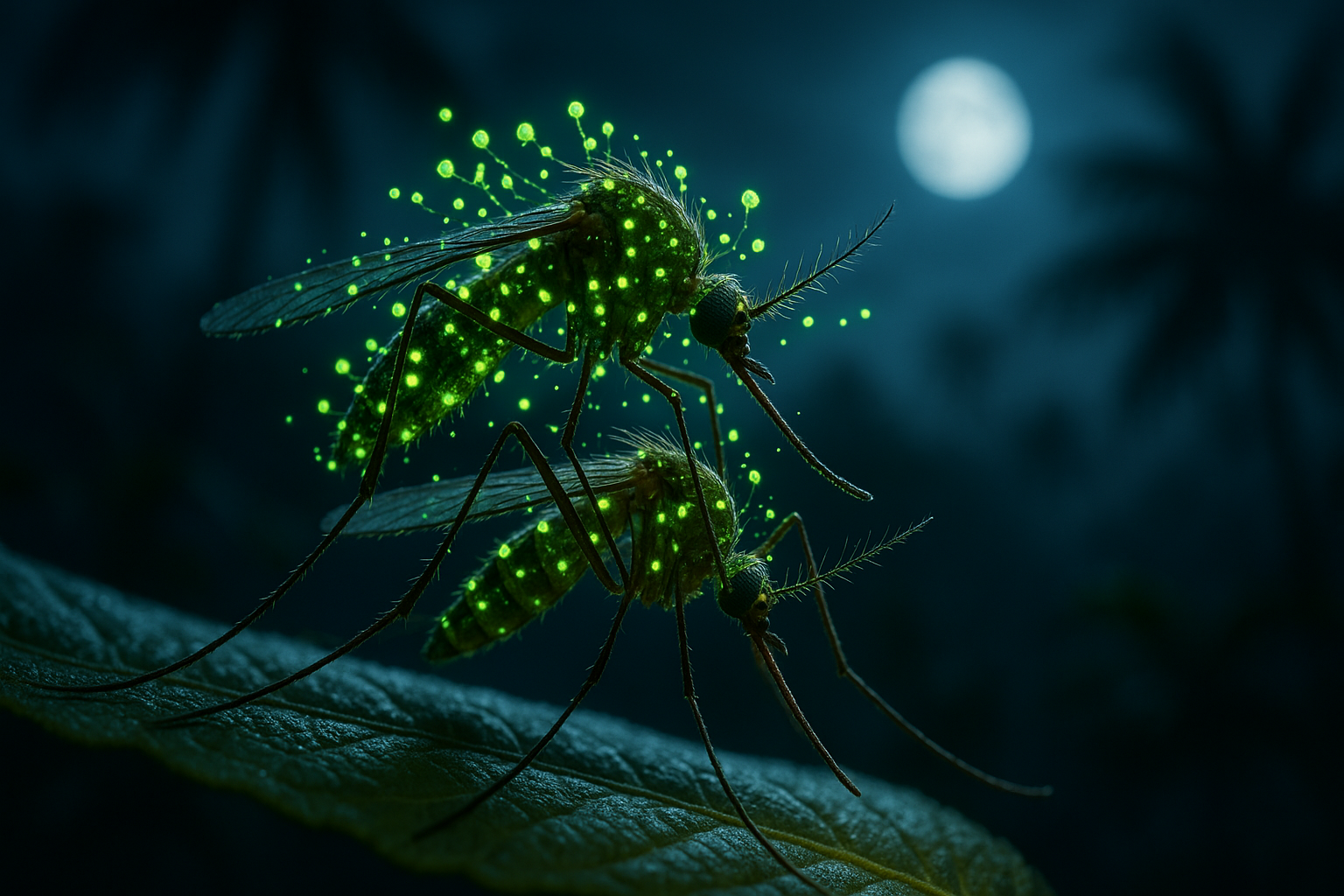

What if mosquito mating could become a way to reduce the spread of malaria?
It sounds unusual, but scientists are investigating an experimental approach that uses genetically engineered, naturally occurring fungi that infect mosquitoes to kill malaria-carrying mosquitoes.
Instead of relying exclusively on insecticide-treated surfaces or spraying, this strategy takes advantage of an important aspect of mosquito behavior: the physical contact that occurs when males and females mate.
In January 2025, researchers led by Etienne Bilgo published a study in Scientific Reports demonstrating that male mosquitoes could transfer genetically engineered fungal spores to females during mating.
The spores were designed to cause lethal infections in mosquitoes.
In controlled laboratory experiments, nearly 90% of females exposed through an experimental mating procedure died within 14 days after mating with males carrying the engineered fungus.
Subsequent research published in 2026 has investigated whether the method could meaningfully reduce mosquito populations and what challenges would arise during larger-scale implementation.
The results suggest an intriguing possibility for malaria prevention. However, the technique remains experimental, and researchers have not demonstrated that it reduces malaria infections in human communities.
Why Scientists Need New Mosquito Control Methods
Mosquitoes are among the most important disease vectors affecting human health.
Different mosquito species can transmit infections such as malaria, dengue, Zika, yellow fever, and chikungunya.
The pathogens responsible for these diseases are different, as are the mosquito species involved.
Malaria is caused by Plasmodium parasites and transmitted through the bites of infected female Anopheles mosquitoes.
According to the World Health Organization’s December 2025 malaria report, there were an estimated 282 million malaria cases and 610,000 malaria deaths worldwide in 2024.
The WHO African Region accounted for approximately 95% of malaria deaths that year.
Children younger than five years face a particularly high risk of severe illness and death.
Preventing mosquito bites and reducing malaria-vector populations are therefore essential parts of public health efforts.
However, conventional mosquito control faces important obstacles.
Why Traditional Insecticides Are Not Enough
Insecticide-treated mosquito nets and indoor residual spraying have contributed substantially to malaria control.
But several factors can undermine their effectiveness.
Some mosquitoes develop resistance to commonly used insecticides, making chemical treatments less effective.
Others increasingly bite or rest outdoors, where indoor interventions may offer less protection.
Environmental conditions, mosquito behavior, and gaps in access to prevention tools create additional challenges.
These problems have encouraged scientists to explore complementary strategies, including biological agents that naturally infect mosquitoes.
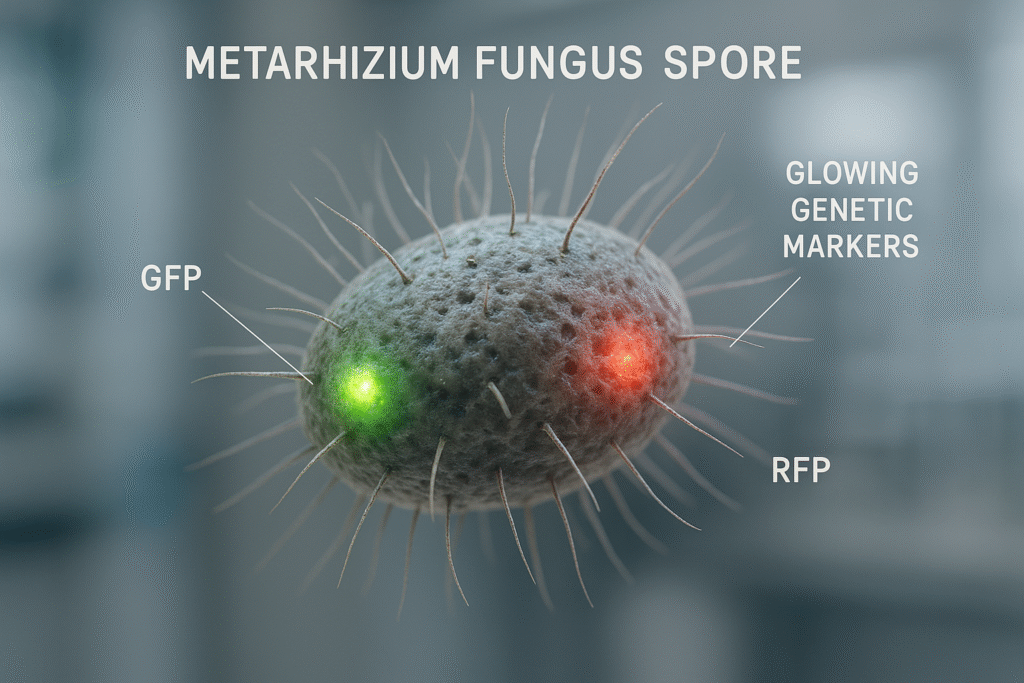
One candidate is a group of fungi known as Metarhizium.
What Is Metarhizium Fungus?
Metarhizium is a genus of fungi containing species capable of infecting and killing insects.
These organisms are known as entomopathogenic fungi, meaning they cause disease in insects.
Unlike conventional chemical insecticides, the fungi act as biological pathogens.
Their spores can attach to the outer surface of a susceptible insect and initiate infection.
Researchers have investigated different Metarhizium species as biological control agents against agricultural pests and disease-carrying mosquitoes.
One species attracting particular attention is Metarhizium pingshaense.
This fungus can infect malaria-vector mosquitoes, including species of Anopheles.
However, naturally occurring fungi may take time to kill mosquitoes, and successful infection can depend on environmental conditions and the amount of fungal exposure.
Scientists have therefore investigated whether genetic engineering could improve the effectiveness of selected fungal strains.
What Makes Transgenic Fungi Different?
A transgenic organism has been genetically modified to contain genetic material introduced through biotechnology.
In the mosquito-control research, scientists engineered a strain of Metarhizium pingshaense to express a toxin designed to act against insects.
The aim was to increase the fungus’s ability to kill susceptible mosquitoes, even when they were exposed to relatively few spores.
The researchers compared the engineered strain with a control fungal strain showing virulence similar to the unmodified fungus.
This allowed them to investigate how genetic modification influenced mosquito mortality.
Importantly, the fungus itself was genetically modified—not the mosquitoes used in the experiments.
That distinction separates this approach from strategies that release genetically modified mosquito populations.
The January 2025 Scientific Reports Study
The key study was titled:
Transmission of Transgenic Mosquito-Killing Fungi During Copulation
It was published on January 16, 2025, in Scientific Reports.
The research team included Etienne Bilgo, Brian Lovett, Abel Souro Millogo, Issiaka Sare, Edounou Jacques Gnambani, Raymond St. Leger, and Abdoulaye Diabaté.
The work involved research institutions in Burkina Faso and the United States.
The scientists investigated whether males carrying mosquito-pathogenic fungal spores could transmit those spores to females during mating.
This question matters because male mosquitoes do not bite humans, yet they participate directly in mosquito reproduction.
Researchers wanted to determine whether males could act as carriers and spread lethal fungal infections to female mosquitoes.
The study used Anopheles coluzzii, an important malaria vector in parts of Africa.
Experiments were conducted under laboratory conditions and in contained semi-field environments designed to reproduce selected aspects of natural mosquito behavior.
How Can a Fungus Spread During Mosquito Mating?
Mosquito mating involves close physical contact between males and females.
The researchers investigated whether fungal spores attached to the male mosquito’s body could transfer to a female during that contact.
If the transferred spores established an infection, the female mosquito could subsequently die from the fungal disease.
This process is called horizontal transmission because the infectious agent moves between individuals rather than being inherited from parents.
The research explored using mating behavior as a biological delivery mechanism.
Rather than requiring every female mosquito to encounter a treated surface, scientists could potentially use males to carry fungal spores into mating encounters.
However, several factors could influence success.
Males would need to survive long enough to mate, remain competitive with untreated males, and carry enough viable spores to transmit an infection.
The study examined some of these questions under controlled experimental conditions.
What Did the Scientists Discover?
The researchers compared female mosquitoes exposed to males carrying ordinary fungal strains, engineered fungal strains, or no fungus.
The findings provided evidence that lethal fungal infections could be transmitted during mating.
Nearly 90% Mortality in a Laboratory Experiment
In artificial forced-mating experiments, the researchers observed that:
- About 89.3% of female mosquitoes that mated with males treated with the engineered fungus died within 14 days.
- Approximately 68% of females mating with males carrying the comparison fungal strain died during the same period.
This difference suggested that the genetically engineered fungus caused greater mortality under the tested conditions.
However, these results came from a specific laboratory mating procedure.
They should not be interpreted as evidence that releasing infected males into the environment would automatically kill nearly 90% of all female mosquitoes.
Natural mosquito populations are more complex, and not every female will mate with a treated male.
Males Remained Capable of Transmitting Fungus for About 24 Hours
The researchers also examined how the period between male exposure and mating affected fungal transmission.
Both fungal strains could produce lethal infections in females when treated males were allowed to mate within approximately 24 hours of exposure.
Transmission effectiveness changed as the time between fungal exposure and mating increased.
At later intervals, the engineered fungus appeared to affect the males themselves, potentially reducing their effectiveness as carriers.
This finding highlights an important trade-off.
A highly lethal fungus may kill mosquitoes more effectively, but if it weakens carrier males too quickly, those males may have fewer opportunities to mate.
An effective real-world strategy would therefore need to balance fungal potency with male mosquito survival and mating success.
What Happened in the Semi-Field Experiments?
The researchers also conducted experiments in contained environments that allowed mosquitoes to mate under more natural conditions.
These tests were designed to investigate whether the strategy could work beyond forced laboratory mating.
One especially informative result concerned female mosquito mortality.
Approximately 26.1% of females in the engineered-fungus treatment group died.
The measured mating rate was approximately 24.4%.
The researchers interpreted the close correspondence as evidence that mating with exposed males was highly likely to result in a lethal fungal infection under those conditions.
By comparison, about 96% of mosquitoes in the untreated control group survived.
The study also found that using fungal treatments shortly before mating did not significantly affect mating rates within the first 24 hours.
These findings support the idea that infected males could transmit fungal infections during mating in a semi-field environment.
However, overall mortality was considerably lower than the nearly 90% observed in the artificial mating experiments.
This difference illustrates why experimental conditions matter when interpreting scientific results.
A successful laboratory mechanism does not automatically translate into equally strong population-level effects.
Why Target Female Mosquitoes Through Males?
Female mosquitoes transmit malaria because they take blood meals.
Male mosquitoes primarily feed on nectar and other sugar sources and do not transmit malaria through biting.
This biological difference makes males attractive candidates for certain mosquito-control methods.
Scientists have already investigated male-based techniques such as the Sterile Insect Technique (SIT).
In SIT programs, large numbers of sterile males may be released to mate with wild females, reducing the production of viable offspring.
The engineered-fungus approach is different.
Instead of relying only on reproductive failure, it aims to infect and kill females through contact during mating.
Researchers suggest combining the two strategies in the future.
For example, a male-based mosquito-control program could potentially incorporate biological agents alongside reproductive-control techniques.
However, such combinations require independent testing.
The 2025 study did not establish that a combined fungus-and-sterile-male program is effective in ordinary community settings.
Learn about sterile mosquito control methods from the CDC.
April 2026 Research: Can the Strategy Reduce Mosquito Populations?
In April 2026, researchers published a mathematical modeling study in Applied Mathematical Modelling.
The paper was titled:
The researchers developed a mathematical framework to investigate whether releasing male mosquitoes carrying engineered fungi could reduce local mosquito populations.
The model considered two potential transmission pathways:
- Transfer of fungal spores during mating.
- Indirect exposure through fungus-colonized mosquito cadavers.
Rather than conducting a large-scale field trial, the researchers used mathematical simulations informed by earlier experimental findings.
This distinction matters because a model’s predictions depend on its assumptions and parameters.
Could the Mosquito Population Decline by More Than 80%?
In one modeled scenario, releasing 10 fungus-exposed males for every wild mosquito every three days over six months produced an estimated 86% reduction in the local female mosquito population.
Another modeled strategy involving daily releases at a ratio of six treated males per wild mosquito required approximately five months to achieve a 90% reduction.
These results suggest that substantial population reductions might be possible under favorable assumptions.
However, they also reveal how demanding the intervention could be.
Repeated releases of large numbers of treated mosquitoes would require significant operational capacity.
The researchers also reported that the fungus persisted in the mosquito population through transmission associated with fungus-colonized cadavers.
Without that pathway, the model did not predict sustained establishment of the fungus.
This means mating-related transmission alone did not ensure that the fungal infection would maintain itself indefinitely in the modeled mosquito population.
The 86% and 90% reductions were simulation results, not reductions observed during field deployment.
They do not establish that the technology would achieve the same effects in real communities.
August 2026: New Research Explores Other Effects of Mosquito-Infecting Fungi
Another study, published in PLOS One on August 10, 2026, investigated how Metarhizium pingshaense affects mosquito survival and reproduction.
The paper was titled:
Researchers examined two locally isolated fungal strains, identified as S10 and S26.
Unlike the original mating-transmission study, this study examined the broader effects of fungal exposure across different mosquito life stages.
The researchers observed that larval exposure increased mortality during development.
They reported approximately 30% mortality during the pupal stage under the tested exposure conditions.
Adult mosquitoes emerging from treated larvae also showed reduced survival compared with controls.
Interestingly, the study found that exposed adult females could lay more eggs, while a smaller proportion of their offspring survived to adulthood.
These findings suggest that fungal infection can affect mosquito biology beyond immediate adult mortality.
However, the experiments used locally isolated fungal strains, not the same genetically engineered strain examined in the 2025 mating-transmission study.
Therefore, the results cannot be treated as direct evidence that the engineered fungus will have identical effects.
Instead, they add to scientists’ understanding of how mosquito-pathogenic fungi influence mosquito populations.
How Does This Compare With Other Emerging Mosquito Control Technologies?
Scientists are investigating several different approaches to controlling mosquito-borne diseases.
Each has distinct advantages and challenges.
Genetically Engineered Fungi
These involve modifying fungi to cause more effective infections in target insects.
The approach discussed here aims to transfer fungal spores through mosquito mating.
Sterile Insect Technique
SIT involves releasing sterile male insects that can mate but produce no viable offspring.
The technology has been investigated for multiple insect species, including mosquitoes.
Genetically Modified Mosquitoes
Some genetically modified mosquito systems aim to reduce mosquito populations by introducing genetic traits that affect offspring survival.
Unlike genetically engineered fungi, these approaches modify the mosquitoes themselves.
Wolbachia-Based Mosquito Control
Wolbachia is a bacterium that naturally occurs in many insect species.
Researchers have developed mosquito-control strategies that use specific Wolbachia strains to interfere with reproduction or reduce mosquitoes’ ability to transmit certain viruses.
Different Wolbachia approaches have different objectives and evidence bases.
None of these methods should be considered interchangeable without examining the target mosquito species and disease.
October 2026: A Separate Genetic-Mosquito Project in Djibouti
On October 15, 2026, the London School of Hygiene & Tropical Medicine announced a project to evaluate genetically modified mosquitoes for malaria control in Djibouti.
The project focuses on Anopheles stephensi, an invasive malaria vector that can thrive in urban environments.
The technology involves self-limiting genetically modified male mosquitoes rather than genetically engineered fungi.
Researchers plan to evaluate changes in mosquito populations, malaria-related outcomes, and community acceptance.
The project illustrates growing interest in new male-based mosquito control approaches.
It does not provide field validation of the transgenic-fungus technology.
Read the October 2026 LSHTM announcement.
Could Engineered Fungi Help Control Insecticide-Resistant Mosquitoes?
Potentially.
One reason researchers are interested in fungal mosquito control is that fungal infections operate differently from conventional chemical insecticides.
Mosquito populations resistant to certain insecticides may still be susceptible to specific fungal pathogens.
The 2025 experiments involved Anopheles coluzzii mosquitoes from a population resistant to multiple insecticides.
This makes the research relevant to areas where conventional mosquito control is becoming less reliable.
However, researchers need to determine whether the fungus remains effective against diverse mosquito populations and under varied environmental conditions.
It is also important to investigate whether mosquitoes could evolve behavioral or physiological defenses against repeated fungal exposure.
Insecticide resistance does not guarantee that a biological alternative will remain permanently effective.
What Are the Environmental and Safety Concerns?
Genetically engineered organisms require careful biosafety assessment before potential environmental use.
The 2025 research was conducted in Burkina Faso with the required ethical and biosafety permissions.
Nevertheless, controlled research authorization is not the same as approval for widespread environmental deployment.
Several questions require further investigation.
Could the Fungus Affect Other Insects?
Researchers must assess whether the engineered fungus could infect non-target insects.
Using insect-selective biological components does not eliminate the need for environmental testing.
Could the Fungus Persist in the Environment?
A fungus that can spread between insects may behave differently in natural environments.
Scientists need to understand how long spores remain viable and whether the engineered strain could persist or spread beyond intended treatment areas.
Could Mosquitoes Develop Resistance?
Mosquito populations may evolve in response to control pressures.
Monitoring for changes in susceptibility would be necessary if fungal-based interventions were eventually deployed.
How Would Communities Be Involved?
Public acceptance is especially important for technologies involving genetically modified organisms.
Residents need access to clear information about possible benefits, uncertainties, environmental safeguards, and the role of regulatory authorities.
Community engagement should occur before any proposed environmental release, not simply after deployment decisions have been made.
What Are the Main Limitations of the 2025 Study?
The original study demonstrated a biological mechanism under controlled conditions, but several limitations remain.
First, the experiments did not measure reductions in human malaria infections.
They evaluated fungal transmission and mosquito mortality.
Second, laboratory mating conditions differ from how mosquitoes behave in nature.
Mosquitoes in the wild encounter complex environments, different mating opportunities, predators, and changing weather.
Third, treated males may have a limited window during which they remain effective carriers.
The researchers observed changes in transmission performance as the time after fungal exposure increased.
Fourth, population-level effectiveness remains uncertain.
The April 2026 modeling study suggests potential reductions but also indicates that large, repeated releases could be required.
Finally, broader environmental safety and operational questions remain unresolved.
Field-based evidence is needed to determine whether the strategy can safely reduce mosquito abundance and, ultimately, malaria transmission.
Is This Technology Available for Public Mosquito Control?
As of October 2026, the mating-transmission method described in the 2025 Scientific Reports paper remains an experimental research strategy.
The sources discussed here do not demonstrate that it has become a routinely deployed or publicly approved malaria-control intervention.
Further work is required to assess effectiveness and safety under real-world conditions.
For households and communities, existing evidence-based malaria prevention remains essential.
The WHO recommends interventions such as insecticide-treated nets and other locally appropriate vector-control measures.
Malaria vaccines are also being introduced for eligible children in endemic areas, alongside other preventive measures.
New technologies should be evaluated as potential additions to effective malaria-control programs rather than immediate replacements for proven interventions.
Read WHO guidance on malaria prevention and control.
What Happens Next?
The next stage of research must move beyond demonstrating fungal transmission during mating.
Scientists must determine whether treated males can compete with wild males, survive long enough to transfer spores, and produce meaningful reductions in mosquito populations outside controlled facilities.
Researchers will also need to examine environmental impacts, manufacturing and release requirements, cost-effectiveness, and the potential for resistance.
If these questions can be addressed satisfactorily, properly regulated field studies may provide stronger evidence of whether the approach could contribute to malaria prevention.
The ultimate objective is not simply to kill mosquitoes in an experiment.
It is to reduce disease transmission safely, reliably, and affordably in the communities most affected by malaria.
Final Takeaway
The discovery that genetically engineered mosquito-killing fungi can spread during mating represents a meaningful advance in experimental biological mosquito control.
The January 2025 Scientific Reports study showed that males carrying engineered fungal spores could transmit lethal infections to females.
Subsequent research published in 2026 expanded the scientific picture by modeling possible population-level effects and investigating additional impacts of fungal infection on mosquito development and reproduction.
However, the technology still faces important challenges involving environmental safety, release strategies, effectiveness in natural mosquito populations, and public health outcomes.
The breakthrough is not that genetically engineered fungi have already defeated malaria. Instead, scientists have demonstrated an additional way to exploit mosquito biology, one that could eventually complement existing prevention tools if future research confirms its safety and effectiveness.
References:
1. Bilgo, E., Lovett, B., Millogo, A. S., et al. (2025). Transmission of transgenic mosquito-killing fungi during copulation. Scientific Reports, 15, 2181.
https://doi.org/10.1038/s41598-024-83242-5
2. Pant, B., Bilgo, E., Mitra, A., et al. (2026). Could malaria mosquitoes be controlled by periodic releases of transgenic mosquitocidal Metarhizium pingshaense fungus? A mathematical modeling approach. Applied Mathematical Modelling, 152, 116540.
https://doi.org/10.1016/j.apm.2025.116540
3. Sare, I., Viana, M., Millogo, S. A., et al. (2026). Maternal and cross-stage effects of Metarhizium pingshaense fungal infection on the malaria mosquito Anopheles coluzzii life-history. PLOS One, 21(8), e0355106.
https://doi.org/10.1371/journal.pone.0355106
4. World Health Organization (2025). Malaria — Fact Sheet.
https://www.who.int/news-room/fact-sheets/detail/malaria
5. World Health Organization (2026). Malaria Vaccines (RTS,S and R21): Questions and Answers.
https://www.who.int/news-room/questions-and-answers/item/q-a-on-rts-s-malaria-vaccine
6. Centers for Disease Control and Prevention. Irradiated Mosquitoes and the Sterile Insect Technique.
https://www.cdc.gov/mosquitoes/mosquito-control/irradiated-mosquitoes.html
7. London School of Hygiene & Tropical Medicine (October 15, 2026). New Study to Evaluate Genetically Modified Mosquitoes for Malaria Control in Djibouti.