

Smoothies have become one of the most widely endorsed strategies for meeting daily fruit and vegetable intake goals. They are convenient, customizable, and generally perceived as nutritionally superior to processed alternatives. Blend enough berries, spinach, and fruit, and you should, in theory, be flooding your body with beneficial plant compounds, polyphenols, flavonoids, and other bioactives linked to cardiovascular protection and cognitive health.
But what if the act of blending certain fruits was actively destroying those compounds, before they ever had a chance to reach your bloodstream?
That is exactly what a carefully designed clinical study published in Food & Function by researchers at the University of California, Davis, and Mars Inc. has found. The culprit is a naturally occurring enzyme called polyphenol oxidase (PPO), and it is present in surprisingly high amounts in one of the most popular smoothie ingredients on the planet: the banana.
What Are Flavan-3-ols and Why Do They Matter?
Before diving into the enzyme chemistry, it’s worth understanding what is at stake. Flavan-3-ols, including epicatechin and catechin, found abundantly in berries, apples, grapes, cocoa, and tea, are among the best-studied dietary bioactives in nutrition science. A growing body of clinical evidence links regular intake of flavan-3-ols to meaningful improvements in cardiovascular health, including better blood flow, lower blood pressure, and reduced risk of heart disease. They have also been associated with cognitive benefits, with recent randomized trials showing improvements in memory function linked to flavan-3-ol intake.
The evidence has been compelling enough for the Academy of Nutrition and Dietetics to issue a formal recommendation that adults consume 400 to 600 mg of flavan-3-ols per day for cardiometabolic protection. Consuming flavan-3-ol-rich fruits and berries, such as apples, pears, and peaches, in smoothies is a logical way to meet that target. Or so it seemed.
The Enzyme That Eats Your Polyphenols
Polyphenol oxidase is the same enzyme responsible for the browning you see when you cut open an apple or a banana and leave it exposed to air. It oxidizes polyphenols, converting them into different chemical species called quinones, which give rise to the characteristic brown discoloration. This process is well documented in food science, and significant effort is made to control PPO activity in commercial food processing to prevent both browning and nutritional degradation.
What was far less understood before this study was what happens when high-PPO fruits are blended with flavan-3-ol-rich ingredients in a home smoothie and then consumed. The researchers set out to answer that question directly.
The Study: Three Ways to Deliver the Same Flavan-3-ols
The trial was conducted at the Ragle Human Nutrition Research Center at UC Davis. Eight healthy men participated in a cross-over design, meaning each person received all three test conditions on separate days, allowing direct within-person comparisons. All participants followed a low-polyphenol diet in the 24 hours before each study day and fasted for 12 hours beforehand to ensure clean baseline measurements.
The three conditions all delivered the same standardized amount of flavan-3-ols (primarily epicatechin from a cocoa extract), but in very different formats:
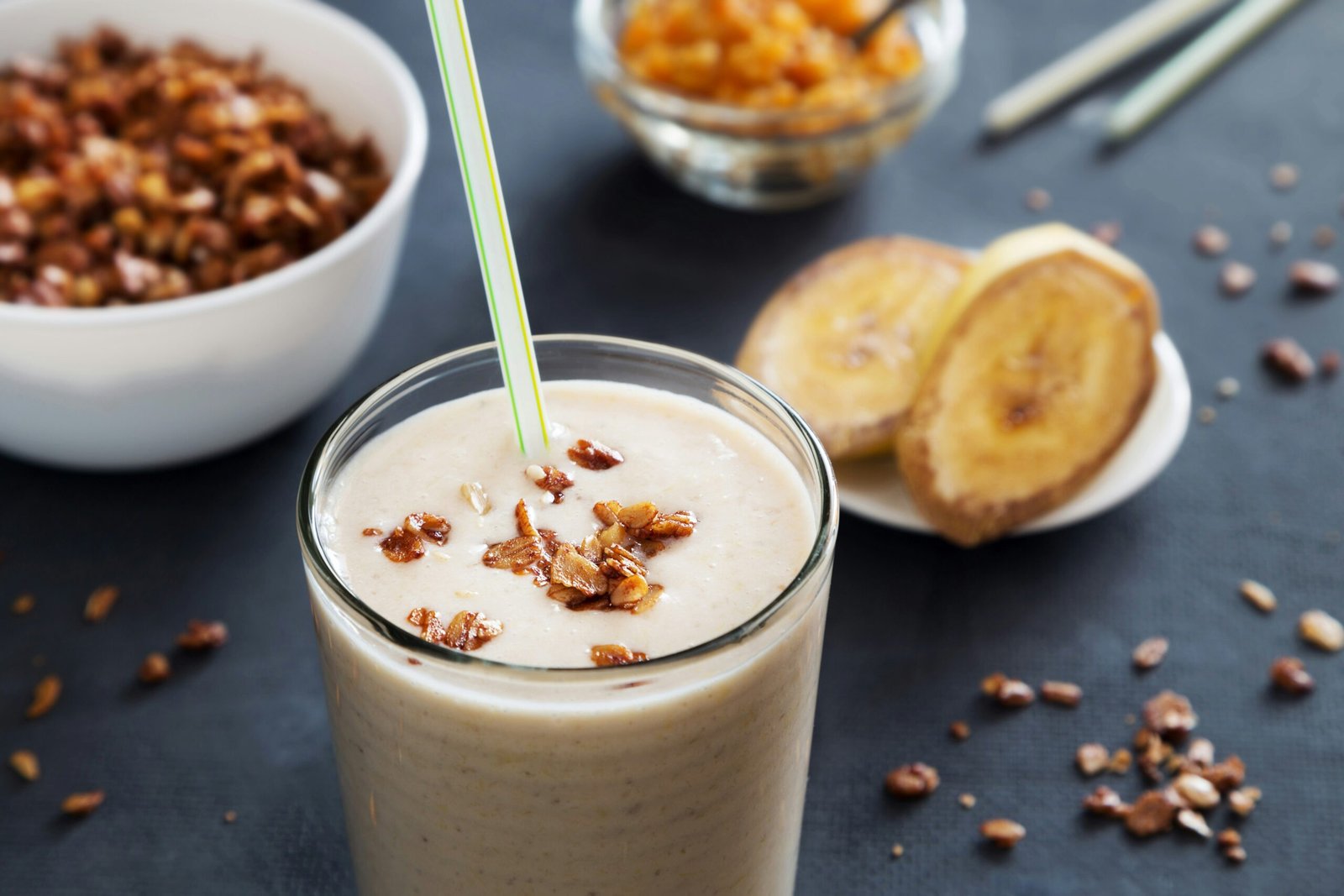
A banana smoothie (high-PPO) blended frozen banana with almond milk, enriched with the standardized flavan-3-ol extract. Banana has exceptionally high PPO activity: the researchers measured approximately 3,258 units per 100 grams of fresh banana, making it the fruit with the highest PPO activity among the 18 fruits, vegetables, and plant products they tested.
A mixed berry smoothie (low-PPO) blended strawberries, blueberries, blackberries, and raspberries with yogurt, almond milk, and water, enriched with the same flavan-3-ol extract. Berries have very low PPO activity, with levels of 12-18 units per 100 g.
A flavan-3-ol capsule taken with milk in the control condition, delivering the same bioactives with no fruit matrix at all.
After each consumption, blood samples were collected at regular intervals over 6 hours to measure the amount of flavan-3-ols that reached the bloodstream.
The Results: An 84% Wipeout
The findings were stark. The peak plasma concentration of flavan-3-ol metabolites after capsule administration was 680 nmol/L, indicating robust absorption. The mixed berry smoothie yielded results almost identical to those of the pure berry smoothie, with peak levels of 659 nmol/L, confirming that low-PPO fruits do not interfere with flavan-3-ol absorption.
The banana smoothie told a radically different story. Peak plasma concentration fell to just 96 nmol/L, an 84% reduction compared to the capsule. The area under the plasma concentration curve over 6 hours, which captures total exposure to flavan-3-ol metabolites, dropped by 81%.
To confirm that the enzyme itself was responsible, the researchers measured epicatechin levels in the banana smoothie immediately after blending and at regular intervals over the following 60 minutes. The results were dramatic: epicatechin disappeared rapidly, with a half-life of under 10 minutes at room temperature. The addition of PPO-specific inhibitors to the smoothie substantially prevented this degradation, confirming PPO as the direct cause. The longer participants waited between preparation and consumption, the worse the bioavailability became.
It Doesn’t Even Need to Touch the Polyphenols First
A second phase of the study was designed to answer an even more unsettling question: Does PPO destroy polyphenols only before ingestion, or can it also act within the body?
In this study, 11 participants consumed the flavan-3-ol drink and the banana drink simultaneously, alternating sips to prevent direct contact between the banana PPO and the epicatechin before swallowing. If PPO only worked in the blender, this approach should have preserved bioavailability.
It did not. While peak plasma concentration was not significantly reduced, total absorption over 6 hours was still 37% lower than when drinking the flavan-3-ol drink without banana. Urine analysis over 24 hours showed approximately 40% less flavan-3-ol metabolite excretion in the banana co-ingestion condition.
The explanation became clearer when the researchers simulated gastric digestion in the laboratory. A banana smoothie incubated under stomach-like conditions (acid pH, digestive enzyme pepsin, and body temperature) for 2 hours retained 68% of its PPO activity. Under these conditions, epicatechin content in the smoothie dropped by 28%. Crucially, the stomach’s pH after eating a meal rises considerably from the typical fasting level of around 2, reaching pH 4 to 5 for up to an hour, a range in which banana PPO is actually more active than at the pH tested in this experiment. It appears that banana PPO can survive gastric conditions well enough to continue degrading polyphenols after they have been swallowed.
Which Fruits Are the Problem and Which Are Fine?
The study tested PPO activity across 18 fruits, vegetables, and plant-based products. The results are a useful practical guide.
High PPO (use with caution): Banana leads the list by far. Beet greens and red delicious apples also showed substantial activity, though lower than that of the banana. Pears, peaches, and avocados had moderate activity.
Low PPO (safe to blend with polyphenol-rich ingredients): Strawberries, blueberries, cucumbers, parsley, mango, oranges, pineapple, kale, and spirulina all had very low or undetectable PPO activity.
Cocoa powder, one of the richest dietary sources of epicatechin, had no detectable PPO activity, meaning cocoa-based additions to smoothies are not subject to this degradation.
The practical implication is clear. Smoothies built around low-PPO berries, with cocoa, greens, or other low-PPO additions, should deliver their polyphenol content efficiently. Smoothies that feature banana as a primary base, as most commercial and home blends do, may deliver far less polyphenol benefit than their ingredient lists suggest.
What This Means for How You Make Smoothies
This research does not mean that bananas have no nutritional value or that they should be avoided entirely. Bananas provide potassium, fiber, B vitamins, and energy from natural sugars. The issue specifically concerns polyphenol bioavailability and the interaction between banana PPO and flavan-3-ol-rich ingredients added alongside it.
The practical guidance that emerges from this study is nuanced. If the health goal is maximizing polyphenol intake from berries, cocoa, apples, or other flavan-3-ol sources, choosing a low-PPO smoothie base such as mixed berries, mango, pineapple, or yogurt-based recipes will preserve far more of that value. If you prefer bananas for their texture, flavor, or other nutritional contributions, separating them from polyphenol-rich additions (eating them at different times rather than blending them) may partially mitigate the loss. However, the post-ingestion effect means this is only a partial solution.
More broadly, this research raises important questions about how we think about food preparation and the role of polyphenols in nutrition. The type of fruit matters. The combination of ingredients matters. How long a smoothie sits before consumption matters. These factors are rarely considered in dietary advice or nutritional surveys, yet they may substantially shape what actually reaches the bloodstream from ostensibly healthy food choices.
The Bottom Line
A landmark controlled study has shown that blending flavan-3-ol-rich ingredients with high-PPO fruits like bananas can destroy up to 84% of their bioavailable polyphenol content both before and after ingestion, through enzyme activity that survives gastric digestion. Mixed berry smoothies made with low-PPO fruits deliver polyphenols with virtually no loss. For anyone looking to maximize the cardiovascular and cognitive benefits of dietary polyphenols through smoothies, the choice of fruit matters far more than most people realize.
Reference
Ottaviani, J. I., Ensunsa, J. L., Fong, R. Y., Kimball, J., Medici, V., Kuhnle, G. G. C., Crozier, A., Schroeter, H., & Kwik-Uribe, C. (2023). Impact of polyphenol oxidase on the bioavailability of flavan-3-ols in fruit smoothies: a controlled, single-blinded, crossover study. Food & Function, 14, 8217–8228. https://doi.org/10.1039/d3fo01599h