


It is as if you can imagine you are inhaling some invisible bites that might destroy your memory and thinking over a long period of time. That is the shocking truth revealed by a landmark systematic review and meta-analysis conducted by The Lancet Planetary Health. In light of urban smog as well as emissions from other industries, our world is scrambling to find the cause of the increased incidence of dementia worldwide, an aspect which this study outlines for the long-term exposure of people to pollutants in the outside air.
Dementia, which affects more than 57 million individuals worldwide, is more than a problem of old age; it is an overwhelming syndrome that affects the ability to live everyday life, and it is amongst the leading causes of mortality. Although genetics and lifestyle are considered, the environmental situation (such as the quality of air) is becoming a modifiable risk. The study conducted by leaders at the University of Cambridge and other areas synthesized the data collected by 51 studies in order to create a clearer picture.
Highlights: Brain Health-related Pollutants
Throughout the study, which involved adults who had been in a situation of air pollution for over a year, it examined the associations with serious cases of new dementia. The researchers combined data on millions of people around the world and developed strict scientific procedures to attain reliability.
PM2.5- The Tiny Killer: These ultrafine particles that are smaller than a hair in the human body were found to be the most associated. The risk of developing dementia increased by 8 percent (hazard ratio 1.08) for every 5 0/m 3 increase in exposure. Appearing in vehicle exhaust and wildfires, PM 2.5 may enter the bloodstream and the brain, which leads to inflammation.
Nitrogen Dioxide (NO2): Found in urbanized regions prone to traffic, a 10 mug/m 3 increase has been associated with a 3 percent increase in risk (hazard ratio 1.03). It is an indicator of city contamination, which causes irritation to the lungs and can even damage brain cells.
Black Carbon/ PM 2.5 Absorbance: This soot-like air pollutant was a risk factor, with an increase of 13 percent per 1 μg /m 3(hazard ratio 1.13), emphasizing the danger of diesel emissions.
There were no established relationships with NOx, PM10, or ozone, but these topics should be looked at further given limited studies. The score of heterogeneity was high, which could be attributed to differences in methods of conducting the studies, but the overall assessment of evidence consistency was moderate.
Subgroup tests showed details: North America and Europe were more strongly connected, as well as with Alzheimer types. Medical-records-based active case-finding methods were associated with stronger relationships, whereas self-reports were associated with weaker relationships.
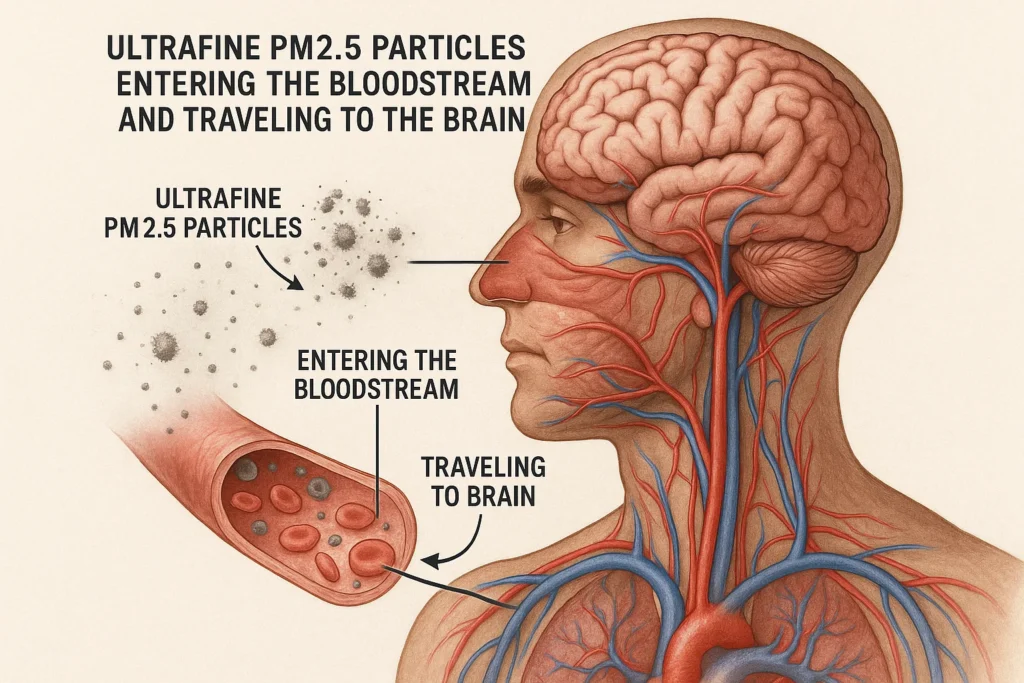
Why Is Pollution Bad to the Brain?
Air pollutants not only impact the lungs; they enter the brain through the blood or nose and cause inflammation, oxidative stress, and the formation of amyloid deposits, which are characteristic of Alzheimer. Blasts of high dose repeated as in aging recreate effects of aging in terms of accelerated decline.
The research brings to attention that mixed dementia (Alzheimer and vascular) is prevalent among older adults, which makes the subtypes a problem. But vascular dementia was found to be connected to PM2.5 and NO2, alluding to the possibility of pollution contributing to damage to the blood vessels.
International Repercussions: An Appeal to a Cleaner Air
Dementia is expected to triple by 2050, so this is not science fiction but a true crisis in health. The elimination of pollution would cut these rates down, saving billions in healthcare expenditure and alleviating families ‘ burdens.
Higher quality standards such as those put in place by the WHO are vital. Cities can encourage EVs, parks, and transportation. In personal life, they should employ air purifiers, skip the rush areas at high foot-traffic times, and advocate policies of clean energy.
The study, which is sponsored by the European Research Council, focuses on gains: clean air translates to healthier brains, economy, and society.
Restrictions and Prospects
Although thorough, the study had limitations: the majority of the research available was conducted in countries with high income rates, possible errors in self-reported findings, and the absence of a demonstration of causality. Publication bias tests indicated asymmetry in PM2.5, suggesting that additional null findings may be present.
Future research should include low-income areas, multipollutant effects, and mechanisms. These estimates could be used to model the burden of disease in order to quantify the number of preventable cases.
Guard Your Brain against the Pollution
You cannot regulate the air, but you can minimize dangers:
Track air quality: Tools such as AirNow monitor local air quality levels, and don’t even go out during a poor day.
Lifestyle Enhancers: Cognitive reserve is generated by exercise, diet, and social activities.
Take Action: Vote in favor of green policies, commit to small things such as carpooling.
This research strengthens air pollution as a risk factor with regard to dementia, and thus there is a need to act on it globally. Take a deep breath because knowledge is power to prevent.
Conclusion
The new connection between dementia and stained air is frightening but solvable. Through reducing pollution of the mind, we are preserving generations. Be knowledgeable, be healthy; clean air is brain care.
References and Resources:
Best Rogowski, C. B., et al. (2025). Long-term air pollution exposure and incident dementia: a systematic review and meta-analysis. The Lancet Planetary Health, 9(7), e266-e280.
https://doi.org/10.1016/S2542-5196(25)00118-4
World Health Organization: Air Quality Guidelines