
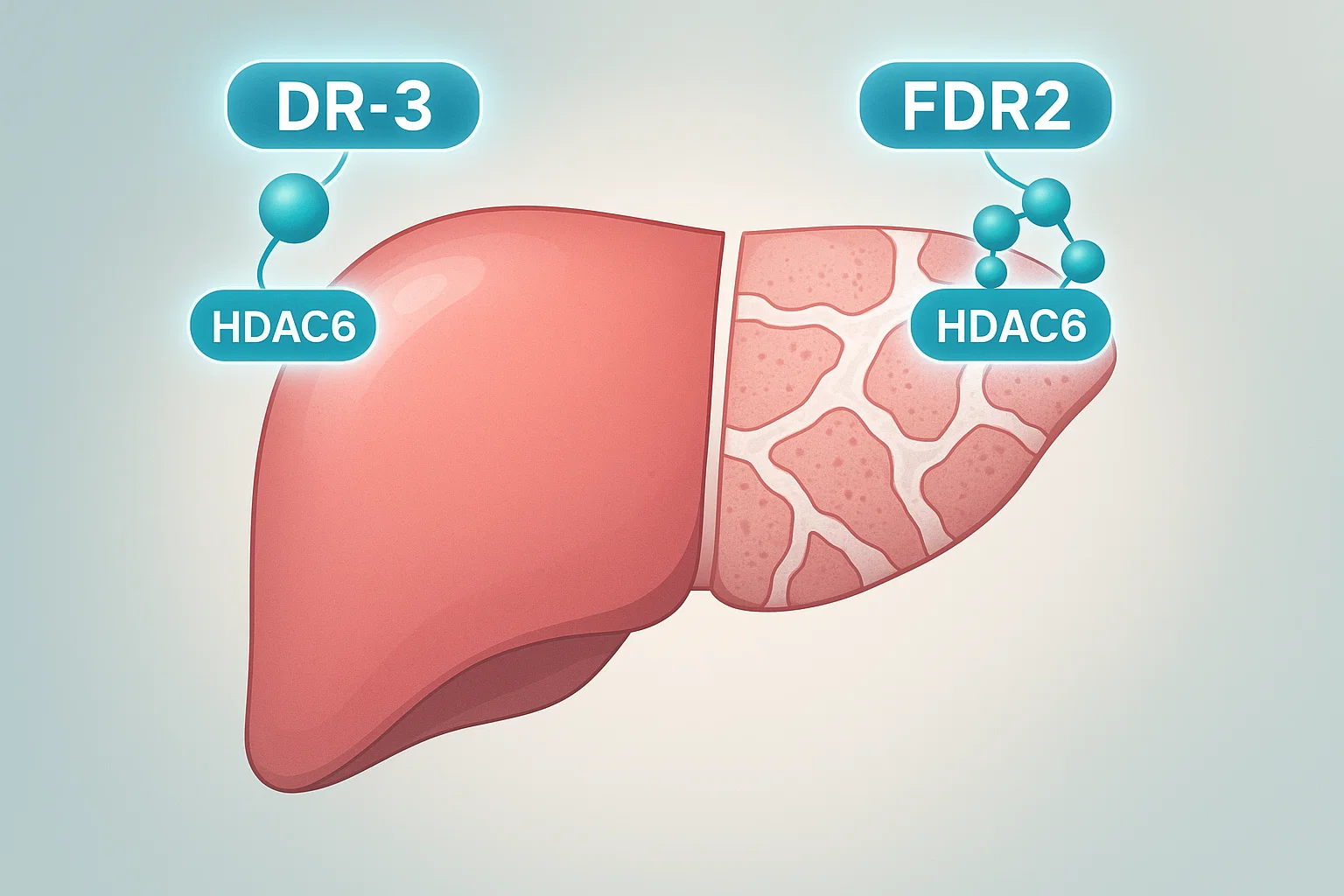

Researchers have identified a promising way to interfere with the biological processes that cause liver scarring. Two experimental compounds, DR-3 and FDR2, reduced fibrosis-related activity in human liver cell and tissue models. Although these findings could support future treatment development, the compounds have not yet been proven safe or effective in patients.
Liver fibrosis occurs when chronic liver damage causes excessive scar tissue to accumulate. If the underlying injury continues, fibrosis can progress to cirrhosis and serious complications.
A March 2025 study identified two promising experimental HDAC6 inhibitors, DR-3 and FDR2, which reduced markers associated with liver scarring.
The researchers tested the compounds in human liver cell models and precision-cut human liver tissue, not in clinical trials involving patients receiving these medicines.
Both inhibitors interfered with important fibrosis-related signaling pathways, including TGF-β1/SMAD signaling, and reduced collagen accumulation in laboratory tissue models.
There are FDA-approved treatments for selected patients with MASH-related liver fibrosis, including resmetirom and semaglutide, but these are not cures for every cause or stage of liver disease.
As of October 2026, DR-3 and FDR2 remain experimental research compounds. Their clinical safety, effectiveness, and ability to reverse established fibrosis in humans remain unknown.
Why Liver Fibrosis Remains a Serious Health Challenge
The liver is one of the body’s most important organs. It processes nutrients, metabolizes medications, produces essential proteins, and helps remove substances from the bloodstream.
It also has a remarkable capacity to regenerate and repair damaged tissue.
However, when liver injury persists for months or years, the normal repair process can become harmful.
Instead of restoring healthy tissue, the liver begins accumulating excessive amounts of scar-like material, particularly collagen.
This process is called liver fibrosis.
Liver fibrosis may develop in people with chronic hepatitis B or C, alcohol-related liver disease, metabolic dysfunction-associated steatotic liver disease (MASLD), and certain autoimmune or inherited liver conditions.
Early fibrosis often produces few noticeable symptoms, making it possible for the disease to progress without being recognized.
Advanced fibrosis can eventually lead to cirrhosis, a condition in which extensive scarring changes the liver’s architecture and interferes with normal function.
Cirrhosis increases the risk of complications including liver failure, portal hypertension, and liver cancer.
Scientists have long searched for treatments capable of directly interrupting scar formation rather than addressing only the underlying liver injury.
A study published in The FEBS Journal in March 2025 provides an intriguing possible direction: targeting an enzyme called histone deacetylase 6, or HDAC6.
What Is HDAC6, and Why Does It Matter in Liver Fibrosis?
HDAC6 is an enzyme belonging to a larger family of proteins called histone deacetylases.
Despite the family’s name, HDAC6 is unusual because many of its important targets are non-histone proteins located in the cell’s cytoplasm.
HDAC6 helps regulate the acetylation of several proteins, including alpha-tubulin, an important component of the cellular skeleton.
Acetylation is a chemical modification that can influence how proteins behave, interact, and participate in cellular processes.
HDAC6 is involved in biological activities such as cell movement, protein regulation, stress responses, and signaling.
Some of these processes are also important in the development of fibrosis.
The Role of Hepatic Stellate Cells
One of the central drivers of liver fibrosis is a specialized cell type known as the hepatic stellate cell.
Under normal conditions, hepatic stellate cells remain relatively inactive and help store vitamin A.
When the liver experiences repeated injury, these cells can become activated.
Activated hepatic stellate cells develop characteristics resembling myofibroblasts, cells that produce extracellular matrix proteins.
These proteins include collagen, which contributes to scar formation.
Although this response initially helps repair damaged tissue, persistent activation results in excessive scar accumulation.
This makes hepatic stellate cells an important target for antifibrotic research.
Scientists are investigating whether selectively blocking HDAC6 can reduce the signals that keep these cells activated.
The 2025 Breakthrough: Two New HDAC6 Inhibitors
On March 14, 2025, researchers published a study in The FEBS Journal titled:
“Pharmacological manipulation of liver fibrosis progression using novel HDAC6 inhibitors.”
The research was conducted by Maria Teresa Borrello, Dusan Ruzic, and colleagues from institutions including Newcastle University and the University of Belgrade.
The investigators developed two experimental compounds:
- DR-3
- FDR2
Both were designed to selectively inhibit HDAC6.
The scientists wanted to determine whether interfering with this enzyme could reduce the activation of hepatic stellate cells and the accumulation of scar-forming proteins.
Their investigation combined molecular modeling, biochemical testing, human liver cell experiments, and precision-cut human liver tissue.
The results suggested that HDAC6 inhibition can suppress several processes associated with fibrosis.
Original research: Borrello et al., The FEBS Journal (2025).
Free full-text article: PubMed Central — PMC12220842.
How Do DR-3 and FDR2 Work?
DR-3 and FDR2 are small molecules designed to interfere with the activity of HDAC6.
Their potential value lies in their ability to target biological processes associated with the formation of liver scar tissue.
1. Selectively Blocking HDAC6
The researchers designed the compounds to interact with structural features of the HDAC6 enzyme.
Laboratory testing showed that both compounds inhibited HDAC6 at nanomolar concentrations.
The reported half-maximal inhibitory concentrations were approximately:
| Compound | HDAC6 inhibitory concentration (IC50) |
|---|---|
| DR-3 | 78.1 nanomolar |
| FDR2 | 50.8 nanomolar |
A lower IC50 indicates that less compound was required to inhibit the enzyme by 50% under the specific experimental conditions.
Both compounds showed approximately 100-fold selectivity for HDAC6 compared with HDAC1 in the biochemical assays.
This selectivity is scientifically important because broad inhibition of multiple HDAC enzymes can interfere with numerous cellular functions.
However, selectivity against HDAC1 alone does not establish that the compounds are completely selective against every related enzyme or free from unintended biological effects.
2. Increasing Alpha-Tubulin Acetylation
HDAC6 normally removes acetyl groups from proteins such as alpha-tubulin.
When HDAC6 activity is inhibited, the acetylation of alpha-tubulin can increase.
The researchers observed increased acetylated alpha-tubulin in treated human liver-derived cells.
This provided evidence that DR-3 and FDR2 were affecting their intended cellular target.
Importantly, increased alpha-tubulin acetylation is a marker of HDAC6 inhibition; it is not, by itself, proof that liver scarring has been reversed.
3. Suppressing TGF-β1/SMAD Signaling
Another important finding concerned a signaling pathway associated with fibrosis.
Transforming growth factor beta 1, commonly abbreviated TGF-β1, is a powerful regulator of tissue repair and scar formation.
In chronic liver injury, excessive TGF-β1 signaling helps promote hepatic stellate cell activation and collagen production.
This pathway involves proteins called SMADs, which transmit signals that can change gene activity.
The researchers found that DR-3 and FDR2 reduced aspects of TGF-β1-induced SMAD signaling in their experimental models.
These findings suggest that inhibiting HDAC6 could interfere with the molecular instructions that encourage scar-producing cells to remain active.
4. Reducing Fibrosis-Related Proteins
The researchers also examined markers associated with activated hepatic stellate cells and extracellular matrix production.
Treatment with the HDAC6 inhibitors reduced several indicators of fibrogenic activity.
This is important because slowing the biological processes that generate scar tissue could be useful in preventing fibrosis from worsening.
However, the laboratory findings do not establish that existing scar tissue can be removed safely or effectively in patients.
Why Testing Human Liver Tissue Matters
One of the strongest aspects of the 2025 investigation was its use of human precision-cut liver slices, often abbreviated hPCLS.
These are thin sections of human liver tissue maintained under controlled laboratory conditions.
Unlike isolated cells, precision-cut tissue retains more of the original organ’s structure and contains several interacting cell types.
This allows researchers to study how experimental treatments affect a more complex biological environment.
For the HDAC6 study, scientists used human liver slices to investigate fibrosis-related responses.
The compounds DR-3 and FDR2 reduced markers of fibrosis, including collagen deposition, in the experimental tissue models.
This provides additional support for HDAC6 as a potential therapeutic target.
Why the Findings Are Encouraging
Testing compounds in human-derived tissue can reveal biological effects that may not be evident in simpler systems.
It can also help researchers identify whether a proposed molecular target is relevant in human tissue.
However, laboratory-maintained liver slices cannot reproduce the full complexity of a living person.
They do not capture all aspects of drug absorption, metabolism, immune responses, long-term toxicity, or disease progression.
Therefore, results obtained from human liver slices should be understood as preclinical evidence, not proof of clinical benefit.
Can HDAC6 Inhibitors Reverse Liver Fibrosis?
This is the central question surrounding the discovery.
The study supports the possibility that blocking HDAC6 could reduce fibrosis-related processes.
It does not demonstrate that DR-3 or FDR2 can reverse established liver fibrosis in patients.
There is an important difference between three outcomes:
Preventing fibrosis progression: Reducing the biological processes responsible for producing additional scar tissue.
Reducing fibrosis markers: Measuring decreases in collagen-related proteins or other indicators of scar formation under experimental conditions.
Reversing established fibrosis: Demonstrating that existing liver scar tissue has decreased and that this improvement is clinically meaningful.
The 2025 study provides evidence primarily related to the first two possibilities in laboratory models.
It does not establish the third in living patients.
This distinction is essential when interpreting headlines about breakthrough fibrosis treatments.
What Has Changed in Liver Fibrosis Treatment by October 2026?
The treatment landscape has changed significantly since the early development of many experimental antifibrotic compounds.
For years, management of liver fibrosis focused mainly on addressing the condition causing liver damage.
Examples include antiviral treatment for chronic viral hepatitis, alcohol cessation for alcohol-related liver disease, and metabolic risk management for MASLD.
These approaches remain essential.
However, medicines specifically approved for certain patients with metabolic dysfunction-associated steatohepatitis (MASH) have now expanded treatment options.
MASH is a more severe form of metabolic liver disease characterized by liver injury and inflammation, sometimes accompanied by substantial fibrosis.
Resmetirom: FDA Approval in March 2024
On March 14, 2024, the U.S. Food and Drug Administration approved resmetirom, marketed as Rezdiffra.
The medication is approved, alongside diet and exercise, for adults with noncirrhotic MASH and moderate-to-advanced liver fibrosis, generally stages F2–F3.
Resmetirom acts as a thyroid hormone receptor-beta agonist.
Its mechanism differs substantially from that of HDAC6 inhibitors.
In a major clinical trial, treatment improved liver-related measures, including fibrosis outcomes, in a proportion of patients.
The approval was granted through the accelerated approval pathway, meaning additional evidence is required to confirm longer-term clinical benefits.
Official source: FDA approval of Rezdiffra for MASH-related liver fibrosis.
Semaglutide: An Important 2025 Development
On August 15, 2025, the FDA approved an additional indication for semaglutide, marketed as Wegovy, for certain adults with MASH and moderate-to-advanced fibrosis.
This approval was also accelerated and applies to a defined population with noncirrhotic MASH.
Clinical trial findings reported that, after 72 weeks:
- Approximately 63% of semaglutide-treated participants achieved MASH resolution without worsening of fibrosis, compared with 34% receiving placebo.
- Approximately 37% experienced improvement in fibrosis without worsening of MASH, compared with 22% receiving placebo.
These results demonstrate that meaningful liver-related improvements are possible for some patients receiving approved therapies.
However, not every patient responds, and longer-term outcomes remain under investigation.
The medication is not approved as a universal treatment for all forms of liver fibrosis.
Official source: FDA approval of Wegovy for MASH.
Updated Clinical Guidance in 2026
Clinical recommendations have also evolved to reflect these treatments.
An updated joint European guidance document published in 2026 discusses the use of resmetirom and semaglutide for appropriate adults with noncirrhotic MASH and significant fibrosis.
It emphasizes individualized treatment decisions, monitoring, management of metabolic conditions, and lifestyle interventions.
Clinical guidance: EASL-EASD-EASO guidance on resmetirom and semaglutide.
These developments are relevant to HDAC6 research because experimental drugs must eventually demonstrate meaningful benefits within an evolving treatment landscape.
How Do HDAC6 Inhibitors Compare With Approved Treatments?
| Treatment | Main mechanism | Evidence | Status in October 2026 |
|---|---|---|---|
| DR-3 and FDR2 | Selectively inhibit HDAC6 to reduce fibrogenic activity | Human cell and tissue laboratory models | Experimental |
| Resmetirom | Activates thyroid hormone receptor-beta | Human clinical trials | FDA-approved for eligible MASH patients |
| Semaglutide | Activates GLP-1 receptors | Human clinical trials | FDA-approved for eligible MASH patients |
| Treatment of underlying causes | Reduces the source of ongoing liver damage | Established clinical evidence across relevant diseases | Standard medical care |
These treatments are not interchangeable.
DR-3 and FDR2 remain research compounds, while resmetirom and semaglutide have specific regulatory indications.
The presence of approved medicines does not eliminate the need for new antifibrotic therapies, particularly for patients with liver disease caused by other conditions or those who do not respond adequately to existing treatment.
Why HDAC6 Remains an Interesting Drug Target
Fibrosis is not a disease affecting the liver alone.
Excessive tissue scarring can also occur in the lungs, kidneys, heart, and other organs.
Although the causes and cellular mechanisms differ, some fibrotic conditions share signaling pathways involving inflammation, myofibroblast activation, and extracellular matrix production.
HDAC6 participates in several cellular processes relevant to these pathways.
This raises the possibility that selective HDAC6 inhibitors could have applications beyond liver fibrosis.
However, potential activity in one experimental model does not prove usefulness in another organ or disease.
Each proposed application would require separate investigations of efficacy, safety, dosing, and clinical relevance.
The wider scientific significance of the 2025 liver study is therefore its identification of a target worth studying further, rather than the discovery of a ready-to-use treatment.
What Challenges Must Researchers Overcome?
Developing HDAC6 inhibitors into approved liver fibrosis medicines would require several additional steps.
1. Confirming Effects in Living Organisms
Laboratory tissue experiments are valuable, but they cannot demonstrate how a drug behaves throughout the body.
Researchers need suitable animal and other preclinical studies to assess whether the compounds reach the liver, produce sustained target inhibition, and improve meaningful fibrosis outcomes.
2. Establishing Safety
HDAC6 regulates multiple cellular functions.
Although selective inhibition may offer advantages over broad HDAC inhibition, researchers must still evaluate possible adverse effects.
Potential concerns include unwanted interactions with other enzymes, toxicity, and effects that appear only after prolonged treatment.
3. Determining Appropriate Dosing
A medicine must reach its intended target at concentrations sufficient to produce a biological effect.
Researchers need to understand how experimental compounds are absorbed, distributed, metabolized, and eliminated.
The concentrations used in cell experiments cannot automatically be translated into human doses.
4. Demonstrating Clinical Effectiveness
Ultimately, human clinical trials would need to determine whether HDAC6 inhibition improves fibrosis and whether those changes translate into meaningful patient benefits.
Outcomes could include improvement in fibrosis stage, preservation of liver function, reduced complications, or other validated clinical measures.
5. Identifying Suitable Patient Groups
Liver fibrosis develops from multiple causes.
An HDAC6-based treatment might not perform equally well in people with viral hepatitis, alcohol-related liver injury, MASH, or autoimmune liver disease.
Researchers would need to establish which populations, if any, might benefit.
How Can Liver Fibrosis Be Managed Today?
While experimental therapies are being investigated, established approaches remain important for people with liver fibrosis.
Management depends on the underlying cause and the severity of liver disease.
For example, antiviral medicines may help control hepatitis-related liver injury.
For alcohol-related liver disease, stopping alcohol consumption is a central part of care.
For people with metabolic liver disease, treatment may include weight management, physical activity, diabetes care, lipid management, and appropriate prescription medicines.
Selected patients with MASH may also qualify for specifically approved treatments.
Clinicians may use blood tests, imaging, elastography, or occasionally liver biopsy to assess liver health and fibrosis severity.
Early recognition and treatment of the underlying condition can sometimes allow fibrosis to improve, although the extent of recovery varies considerably.
People with suspected or diagnosed liver fibrosis should seek individualized advice from a qualified healthcare professional.
Experimental HDAC6 inhibitors should not be used outside appropriately regulated research settings.
Conclusion: A Promising Discovery That Still Needs Clinical Testing
The discovery of selective HDAC6 inhibitors DR-3 and FDR2 represents a meaningful step in understanding how liver fibrosis might be targeted at the molecular level.
The 2025 study demonstrated that interfering with HDAC6 activity can reduce several processes associated with scar formation, including hepatic stellate cell activation, fibrosis-related signaling, and collagen deposition in experimental human liver models.
These findings support further investigation of HDAC6 as an antifibrotic drug target.
However, the study does not establish that the compounds safely reverse liver fibrosis in patients.
The broader treatment landscape has also progressed. FDA-approved therapies now offer specific options for eligible patients with MASH-related liver fibrosis, demonstrating that measurable improvement is possible in some clinical settings.
The promise of HDAC6 inhibition lies in what future research may establish—not in a treatment already proven to work in people.
For patients living with chronic liver disease, the most important priorities remain early diagnosis, management of the underlying cause, appropriate clinical monitoring, and access to evidence-based care.
Continued scientific research may eventually expand these options further.
References
1. Borrello, M. T., Ruzic, D., et al. (2025). Pharmacological manipulation of liver fibrosis progression using novel HDAC6 inhibitors. The FEBS Journal, 292(13), 3397–3411.
https://doi.org/10.1111/febs.70062
2. Borrello et al. (2025). Free full-text version of the HDAC6 inhibitor study. PubMed Central.
https://pmc.ncbi.nlm.nih.gov/articles/PMC12220842/
3. U.S. Food and Drug Administration (2024). FDA Approves First Treatment for Patients with Liver Scarring Due to Fatty Liver Disease.
https://www.fda.gov/news-events/press-announcements/fda-approves-first-treatment-patients-liver-scarring-due-fatty-liver-disease
4. U.S. Food and Drug Administration (2025). FDA Approves Treatment for Serious Liver Disease Known as MASH.
https://www.fda.gov/drugs/news-events-human-drugs/fda-approves-treatment-serious-liver-disease-known-mash
5. U.S. National Library of Medicine (2026). Rezdiffra (resmetirom) FDA-approved prescribing information.
https://dailymed.nlm.nih.gov/dailymed/drugInfo.cfm?setid=e67ea09f-a840-439c-86c8-f98585f978b2
6. EASL-EASD-EASO (2026). Guidance on the use of resmetirom and semaglutide as MASH-targeted therapy.
https://pubmed.ncbi.nlm.nih.gov/42805503/