


Not all olive oil is the same. That sentence might seem like food marketing copy, but a major new study published in Microbiome (2026) has turned it into a serious scientific statement, and the implications for brain health are striking.
The research tracked 656 older adults over 2 years, measuring their olive oil consumption, gut microbiome composition, and performance on 8 neuropsychological tests. What it found challenges the assumption that olive oil is simply a healthy fat: virgin olive oil and regular (common) olive oil produced diametrically opposite effects on memory and cognitive function, and the gut microbiome appears to be the mechanism driving much of that difference.
This is one of the most detailed human studies to date examining the full chain from diet to gut to brain, and the results are compelling enough to make you think twice about what’s in the bottle on your kitchen shelf.
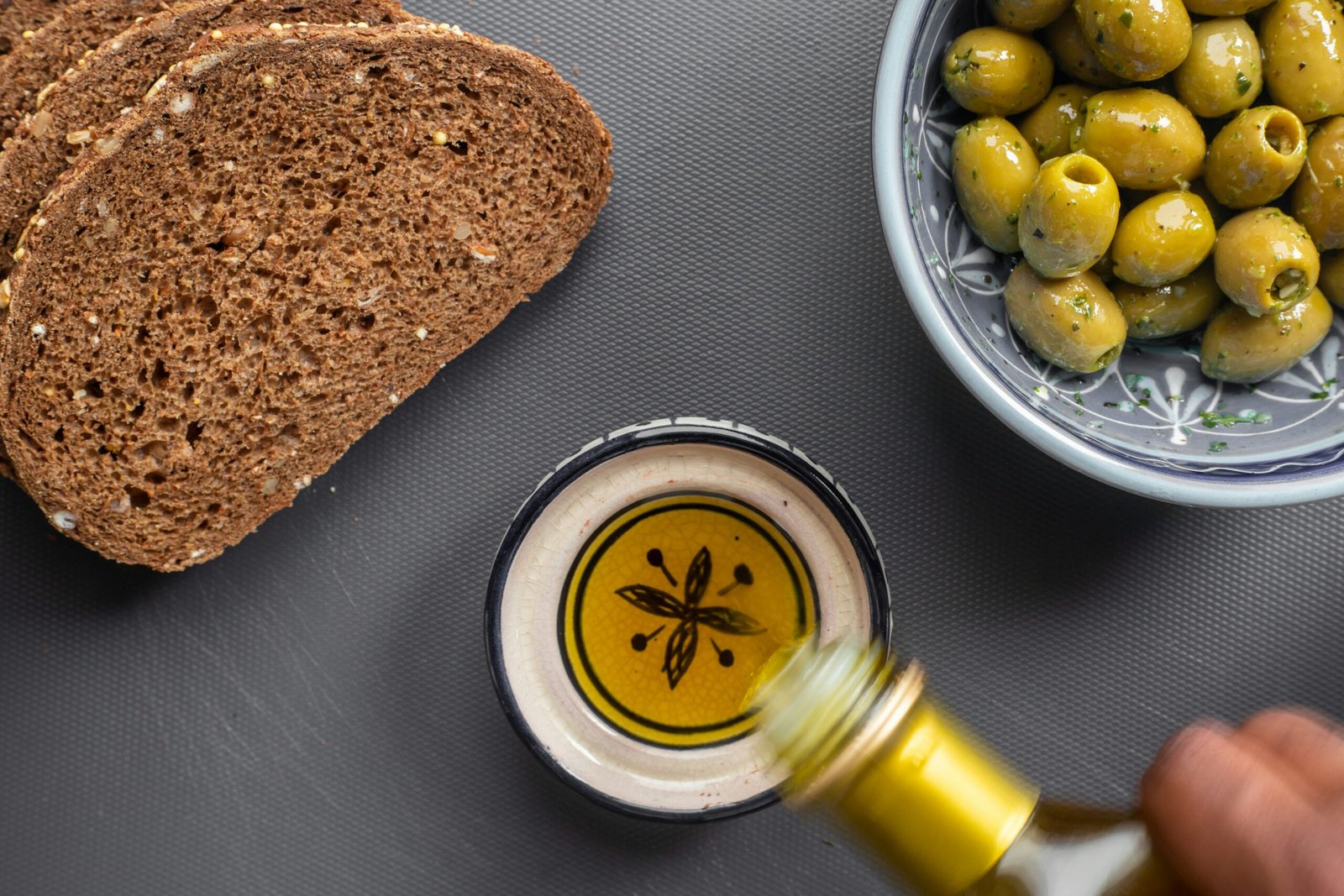
Two Kinds of Olive Oil, Two Very Different Outcomes
First, a distinction that most people and even many researchers tend to gloss over.
Virgin olive oil (VOO), including extra virgin olive oil, is extracted directly from olives solely by mechanical means, without industrial refining. It retains its full complement of bioactive compounds: polyphenols (particularly hydroxytyrosol and oleuropein), tocopherols (a form of vitamin E), and phytosterols. These compounds have well-established antioxidant and anti-inflammatory properties.
Common olive oil (COO), by contrast, is predominantly refined. The refining process strips away most of those bioactive compounds, leaving behind a fatty acid profile similar to that of virgin olive oil, with comparable monounsaturated fat content but little of the polyphenol richness that gives virgin olive oil its distinctive health benefits. Common olive oil is what fills most budget supermarket shelves and is used in most mass-produced food.
Most studies on olive oil and health have lumped these two types together, treating them as equivalent. This study didn’t, and that decision proved decisive.
What the Study Found: Memory Gains vs. Memory Loss
Researchers from the PREDIMED-Plus trial, a major ongoing Mediterranean diet study conducted across multiple Spanish research centers, analyzed a subgroup of 656 adults aged 55 to 75, all of whom had overweight or obesity and metabolic syndrome, and none of whom were diagnosed with dementia at the start of the study. These were precisely the kind of individuals at elevated risk of cognitive decline, making the findings especially relevant for prevention.
Participants completed comprehensive dietary assessments and a battery of cognitive tests measuring global cognition, general cognitive function, executive function, attention, and language both at the start of the study and two years later. They also collected baseline stool samples, which were analyzed to characterize their gut microbiome.
The results from the multivariable analyses were striking in their clarity:
For every additional 10 grams of virgin olive oil consumed per day (roughly 1 tablespoon), participants showed measurable improvements in global, general, executive, and language functions over the 2-year follow-up. The relationship was dose-dependent; the more virgin olive oil consumed, the better the cognitive outcomes.
For every additional 10 grams of common olive oil consumed per day, the picture reversed. Higher consumption of common olive oil was associated with accelerated decline in executive function, and the highest consumers showed significantly steeper declines in global cognitive function, general cognitive function, executive function, and language compared to the lowest consumers.
Two olive oils. One is associated with cognitive preservation. The other is associated with cognitive acceleration in the wrong direction.
The Gut Connection: How Your Microbiome Carries the Message
Here is where the study becomes particularly interesting and contributes something genuinely new to science.
The researchers didn’t just measure cognitive outcomes. They asked a deeper question: why might different olive oils produce such different effects on the brain? And their answer pointed squarely at the gut microbiome.
Higher consumption of virgin olive oil was associated with greater gut microbial diversity, more species richness, and greater evenness among microbial communities. A diverse microbiome is generally considered a hallmark of gut health, associated with better metabolic function, reduced inflammation, and stronger immune regulation.
Common olive oil consumption, by contrast, was associated with lower alpha diversity, a less rich, less balanced microbial ecosystem.
Beyond diversity, specific bacterial genera were differentially associated with each oil type. Virgin olive oil consumption was linked to higher levels of bacteria, including Bacteroides, Phascolarctobacterium, and Acidaminococcus, and lower levels of several other genera. Common olive oil was associated with higher abundance of Adlercreutzia, Eubacterium hallii group, and Streptococcus, and lower levels of Faecalibacterium, a key butyrate-producing bacterium whose depletion has been linked to depression and inflammatory conditions.
The most important finding from the mediation analysis was the role of a genus called Adlercreutzia. This bacterium emerged as a significant mediator of the relationship between virgin olive oil consumption and changes in general cognitive function. Specifically, higher virgin olive oil consumption was associated with lower Adlercreutzia abundance, and, in turn, lower Adlercreutzia abundance was associated with better cognitive outcomes. The bacterium appeared to account for approximately 20% of the total effect linking virgin olive oil to improved general cognitive function.
This is the first human study to identify Adlercreutzia as a potential mediator of the relationship between dietary fat and cognitive change, a finding that opens an important new line of inquiry into the gut-brain axis.
Why Do Polyphenols Make Such a Difference?
The likely explanation for the divergent effects of the two oil types comes back to those bioactive compounds: the polyphenols abundant in virgin olive oil, which are stripped away in the refining process that produces common olive oil.
Two compounds in particular, hydroxytyrosol and oleuropein, have been shown in laboratory and animal studies to cross the blood-brain barrier and accumulate in brain regions, including the hippocampus, the seat of memory formation. Once there, they appear to reduce the buildup of amyloid-beta plaques and tau protein tangles (hallmarks of Alzheimer’s pathology), suppress neuroinflammation, and protect neurons from oxidative damage.
But they may also act indirectly by remodeling the gut microbiome, with downstream effects on the brain. Polyphenols are metabolized by gut bacteria, and the resulting metabolites, including short-chain fatty acids, can cross the gut-blood barrier, reduce systemic inflammation, improve blood-brain barrier integrity, and even modulate neurotransmitter synthesis.
This is the olive oil gut-brain pathway the researchers describe. The polyphenols in virgin olive oil shape the microbiome; the microbiome shapes the metabolites; the metabolites shape the brain environment.
Common olive oil, stripped of those polyphenols by industrial refining, may simply not provide that same downstream cascade despite sharing a similar fatty acid profile on paper.
Context and Caveats
This was an observational study. The researchers controlled for age, sex, education, BMI, physical activity, smoking, depression, diabetes, hypertension, and Mediterranean diet adherence, a thorough list, but an observational design cannot establish causality with certainty. Residual confounding from unmeasured factors is always possible.
The study population was also specific: older Spanish adults with metabolic syndrome, from a Mediterranean context where olive oil is a dominant dietary fat. People in these regions consume mostly virgin olive oil, making it somewhat unusual that any participants were consuming meaningful amounts of common olive oil. This context may limit how directly the findings translate to populations with different baseline diets.
The gut microbiome data were collected at a single time point, which means the researchers could not fully establish the temporal sequence of the oil-microbiome-cognition pathway. And common olive oil consumption in this cohort was relatively low compared with virgin olive oil, warranting caution in interpreting the magnitude of its associations.
Despite these limitations, the consistency of findings across multiple cognitive domains, across continuous and categorical analyses, and across sensitivity analyses is notable.
What This Means for Your Plate
The study’s practical takeaway is simple, even if the science behind it is complex: the label on your olive oil bottle matters more than you might think for long-term brain health.
If you are using olive oil primarily because of its reputation as a heart-healthy fat, you may be getting that benefit regardless of the type; the fatty acid profiles are similar. But if you are using olive oil as part of a strategy for healthy aging and cognitive protection, the type of olive oil appears to matter significantly. Extra virgin or virgin olive oil retains the polyphenols that appear to drive the brain benefits. Refined common olive oil, whatever its other culinary merits, may not.
For anyone following or considering a Mediterranean dietary pattern, consistently ranked among the strongest approaches for dementia prevention, prioritizing virgin olive oil over refined varieties appears to be a meaningful and accessible upgrade.
The Bottom Line
A bottle of olive oil is not simply a bottle of fat. The biological activity it contains depends critically on how it was made. Virgin olive oil’s polyphenols appear to do something that refined olive oil cannot: they reshape the gut microbiome in ways that cascade all the way to the brain, slowing the rate of cognitive decline over years of follow-up.
In a world where dementia prevention remains one of medicine’s most urgent unsolved problems, this kind of dietary specificity, knowing not just that a food helps, but how and through which biological pathway, represents meaningful scientific progress.
References
Ni, J., Nishi, S.K., Babio, N., Belzer, C., Vioque, J., Corella, D., … & Salas-Salvadó, J. (2026). Total and different types of olive oil consumption, gut microbiota, and cognitive function changes in older adults. Microbiome, 14, 68. https://doi.org/10.1186/s40168-025-02306-4