

A growing body of research suggests that Alzheimer’s disease entails more than the accumulation of abnormal proteins in the brain. Scientists are also investigating the role of iron, oxidative stress, and the gradual breakdown of the protective systems that keep brain cells healthy.
A study published in Alzheimer’s & Dementia in June 2025 identified unusually high iron levels. It increased oxidative damage in brain tissue from people with Down syndrome who had developed Alzheimer’s disease.
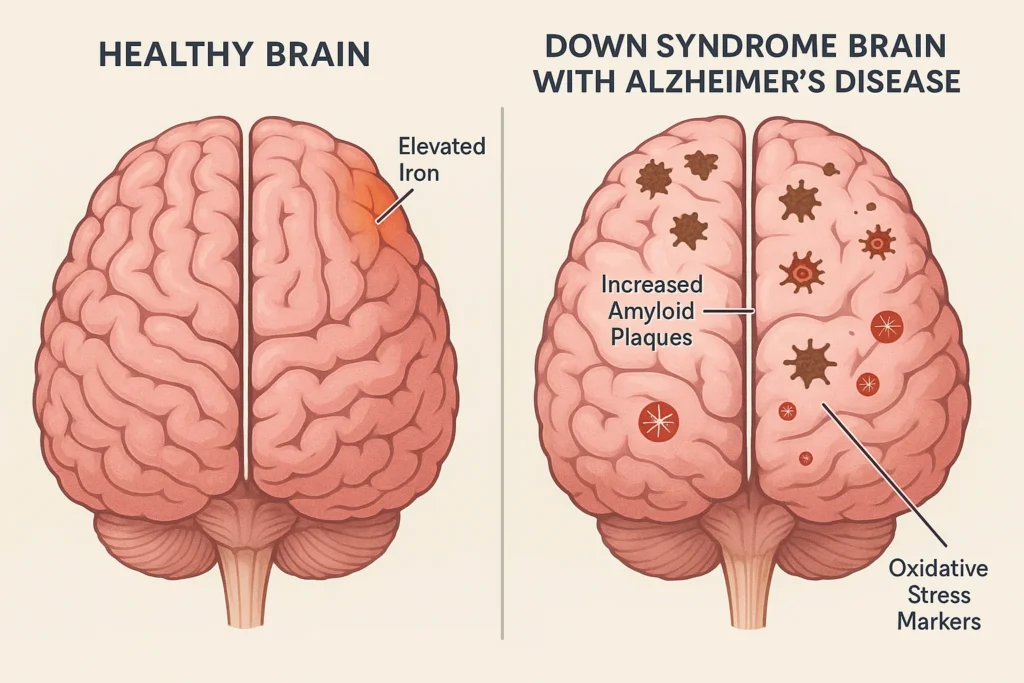
Researchers found that iron concentrations in the prefrontal cortex were approximately twice as high in the Down syndrome–Alzheimer’s group as in the comparison groups. They also identified changes in antioxidant defenses associated with ferroptosis, an iron-dependent form of regulated cell death.
The findings give an important clue about why Alzheimer’s-related brain damage may develop unusually early in people with Down syndrome. However, the study does not establish that ferroptosis directly causes dementia or that preventing it will slow disease progression.
The original peer-reviewed study, led by Max A. Thorwald and colleagues, was published on June 19, 2025.
Why Are People With Down Syndrome at Greater Risk of Alzheimer’s?
Down syndrome is a genetic condition most commonly caused by an extra copy of chromosome 21, referred to as trisomy 21.
This chromosome contains the amyloid precursor protein (APP) gene, which plays an important role in Alzheimer’s disease.
Having an additional copy of APP can increase the production of amyloid-beta, a protein fragment which accumulates into plaques in the brains of people with Alzheimer’s disease.
According to the US National Institute on Aging, most people with Down syndrome develop characteristic Alzheimer’s-related brain changes, including amyloid plaques and tau tangles, by approximately age 40.
However, developing these changes does not necessarily mean a person has dementia.
Clinical symptoms can appear years or decades later, and the timing varies considerably between individuals.
The National Institute on Aging estimates that at least half of people with Down syndrome develop Alzheimer’s dementia as they age.
This unusually high risk has made Down syndrome an important area of research into the biological processes behind Alzheimer’s disease.
Source: National Institute on Aging — Alzheimer’s Disease in People With Down Syndrome.
What Is Ferroptosis, and Why Does Iron Matter?
Iron is essential for normal brain function. It supports oxygen-related processes, energy production, and many enzymes’ activity.
But iron must remain carefully regulated.
When excess reactive iron accumulates inside or around cells, it can promote chemical reactions that harm cell membrane fats. This process is known as lipid peroxidation.
If oxidative damage overwhelms the cell’s protective systems, it can contribute to ferroptosis.
Unlike apoptosis, another regulated form of cell death, ferroptosis is characterized by iron-dependent oxidative destruction of membrane lipids.
The brain may be particularly vulnerable because its cells contain lipid-rich membranes, require substantial energy, and depend on carefully controlled antioxidant defenses.
One crucial protective enzyme is glutathione peroxidase 4 (GPX4). It helps remove damaging lipid peroxides before they are able to destabilize cell membranes.
When this protective system becomes impaired, cells may become more susceptible to ferroptotic injury.
Importantly, finding molecular signs associated with ferroptosis in brain tissue is not the same as directly demonstrating that neurons died through ferroptosis.
That distinction is essential when interpreting the Down syndrome research.
What Did the 2025 Study Discover?
The research team included scientists from the University of Southern California, the University of California, Irvine, and the University of California, Merced.
They examined donated postmortem brain tissue from three groups:
- People without Alzheimer’s-related cognitive impairment who served as controls.
- People with Alzheimer’s disease without Down syndrome.
- People with Down syndrome and Alzheimer’s disease.
Researchers analyzed samples from the prefrontal cortex, a brain region involved in planning, decision-making, and other higher cognitive functions, alongside samples from the cerebellum.
They measured tissue iron, iron-regulating proteins, antioxidant defenses, and molecular indicators of lipid damage.
1. Brain Iron Levels Were Approximately Twice as High
One of the most striking findings was a roughly twofold increase in iron concentration in the prefrontal cortex of the Down syndrome–Alzheimer’s group compared with both other groups.
This suggests that abnormal iron accumulation may be especially pronounced in this brain region.
The researchers also examined cerebral microbleeds, small areas of bleeding in the brain that can leave behind iron-containing blood products.
They proposed that microbleeds could contribute to iron accumulation and oxidative damage, although the study did not establish that microbleeds were the sole cause of the elevated iron.
2. Researchers Found Greater Damage to Cell Membrane Lipids
The team measured 4-hydroxynonenal (4-HNE), a molecule produced when membrane lipids undergo oxidative damage.
Higher 4-HNE levels can indicate increased lipid peroxidation.
The researchers found more pronounced lipid oxidation in the Down syndrome–Alzheimer’s group, particularly in the prefrontal cortex.
This combination of excess iron and lipid damage is consistent with biological conditions that favor ferroptosis.
3. Important Antioxidant Defenses Were Weakened
The study found that GCLM, a protein involved in glutathione production, was reduced by approximately 50% in both Alzheimer’s groups compared with controls.
Glutathione is a major cellular antioxidant and supports several enzymes that help protect against oxidative injury.
The researchers also reported that GPX4 activity in specialized cell membrane regions, called lipid rafts, was reduced by at least 30% in the Alzheimer’s groups.
These results indicate that some of the brain’s mechanisms for defending against oxidative damage may be compromised.
The results matter because damage to membrane lipids and reduced antioxidant protection are able to reinforce each other.
4. Iron Accumulation May Be Connected to Amyloid Processing
The researchers also examined lipid rafts, small specialized regions within cell membranes where proteins involved in amyloid processing can interact.
They reported changes in enzymes involved in APP processing, including lowered alpha-secretase activity and increased beta-secretase activity.
Beta-secretase helps initiate a pathway that can produce amyloid-beta, whereas alpha-secretase processes APP through a pathway that prevents formation of the amyloid-beta fragment at that cleavage site.
The data show that oxidative membrane damage and altered amyloid processing may be connected.
However, the results cannot determine whether iron accumulation comes before amyloid pathology, develops as a consequence of it, or participates in a more complicated feedback cycle.
The central finding is an association between increased brain iron, lipid oxidation, weakened antioxidant defenses, and Alzheimer’s-related pathology, not proof of a single causal pathway.
Read the complete research paper: Down Syndrome With Alzheimer’s Disease Brains Have Increased Iron and Associated Lipid Peroxidation Consistent With Ferroptosis.
Could Iron Overload Help Explain Earlier Alzheimer’s Damage?
Scientists have long recognized that the additional APP gene copy on chromosome 21 plays a major role to Alzheimer’s risk in Down syndrome.
The new findings show that APP-related abnormalities may interact with iron regulation and oxidative stress.
One possible model is that amyloid-related changes, vascular damage, and disrupted iron handling make certain brain regions more vulnerable to membrane oxidation.
At the same time, weakened antioxidant protection could make it harder for neurons and surrounding cells to recover from that damage.
This could potentially contribute to the processes underlying neurodegeneration.
However, other mechanisms, including tau pathology, inflammation, mitochondrial dysfunction, vascular abnormalities, and genetic differences, add to Alzheimer’s disease.
Ferroptosis should therefore be considered a potential contributor rather than a complete explanation for early-onset Alzheimer’s pathology in Down syndrome.
What Has Research Added Since the Initial Study?
Research published after the June 2025 paper has continued examining the connection between oxidative stress, chromosome 21 genes, and Alzheimer’s-related brain damage.
An October 2026 review in Neurochemistry International examined the BACH1/HO-1 signaling pathway.
BACH1 is encoded by a gene on chromosome 21 and helps regulate cellular responses to oxidative stress.
The review discusses how abnormal regulation of this pathway may contribute to impaired antioxidant responses and greater vulnerability to neural degenerative processes, including ferroptosis.
It also identifies the BACH1 and NRF2 pathways as possible areas for future therapeutic research.
These findings deliver additional biological context, but they do not establish that targeting these pathways prevents Alzheimer’s dementia in people with Down syndrome.
Could Blocking Ferroptosis Lead to New Alzheimer’s Treatments?
Reducing iron-related oxidative damage is an active area of scientific investigation.
Researchers are investigating methods to stabilize iron metabolism, protect vulnerable membrane lipids, or strengthen cellular antioxidant responses.
These approaches include investigating iron-binding compounds, ferroptosis inhibitors, and pathways that regulate GPX4, glutathione, and related protective systems.
However, promising biological mechanisms do not automatically lead to successful treatments.
Before a ferroptosis-targeting approach could become an established therapy, researchers would need to demonstrate that it can safely reach relevant brain tissues, reduce harmful biological processes, and preserve meaningful cognitive function in well-designed clinical trials.
There is currently no established clinical treatment proven to prevent or reverse Alzheimer’s dementia in people with Down syndrome by blocking ferroptosis.
The research also does not justify taking iron-chelating medications, high-dose antioxidants, or changing prescribed iron treatment independently.
Iron is essential to health, and reducing it without medical supervision may cause harm.
What Are the Limitations of the Research?
Although the study presents valuable evidence, several limitations affect how its conclusions should be interpreted.
First, the research examined human brain tissue collected after death. This allows scientists to identify biological abnormalities but cannot show exactly when those changes developed during a person’s lifetime.
Second, the study used relatively small tissue groups. Findings from limited samples require confirmation in larger, more diverse populations.
Third, the comparison groups differed in important characteristics, including age. Such differences may complicate the interpretation of changes in iron regulation and oxidative stress.
Fourth, measuring iron, lipid peroxidation, and antioxidant activity does not directly establish that ferroptosis caused the loss of neurons.
Finally, the findings do not establish whether excess iron initiates Alzheimer’s-related damage, accelerates existing pathology, or accumulates in response to other disease processes.
Longitudinal studies following adults with Down syndrome over time will be important for clarifying these questions.
What Does This Mean for People With Down Syndrome and Their Families?
The study strengthens researchers’ understanding of the multiple biological processes associated with Alzheimer’s disease in Down syndrome.
It does not mean that everyone with Down syndrome will develop dementia, nor does it indicate that elevated dietary iron necessarily causes Alzheimer’s disease.
For families and caregivers, the most immediate practical message remains the significance of recognizing meaningful changes from a person’s usual abilities and behavior.
These might include changes in memory, daily living skills, communication, personality, sleep, or independence.
Such symptoms are not specific to Alzheimer’s disease and may have other treatable causes.
Clinical evaluation is therefore essential rather than assuming that every change represents dementia.
The National Institute on Aging’s Alzheimer Biomarkers Consortium–Down Syndrome is among the research programs studying biological markers that may help identify Alzheimer’s-related changes earlier and improve understanding of disease progression.
Conclusion: A New Clue, Not Yet a New Cure
The discovery of elevated brain iron and molecular changes associated with ferroptosis adds an important dimension to the understanding of Alzheimer’s disease in Down syndrome.
The data show that Alzheimer’s-related damage may involve an interaction between amyloid processing, iron accumulation, oxidative stress, and impaired antioxidant protection.
They also raise important questions about whether protecting vulnerable cell membranes could eventually help slow neurodegeneration.
For now, the strongest conclusion is that iron-related oxidative injury deserves further investigation as a potential contributor to Alzheimer’s disease in Down syndrome.
Determining whether ferroptosis directly drives neuronal loss, and whether blocking it improves outcomes, will require additional studies.
The research offers a encouraging direction for future investigation, but it does not yet provide a new treatment.
References
- Thorwald, M. A., et al. (2025). Down syndrome with Alzheimer’s disease brains have increased iron and associated lipid peroxidation consistent with ferroptosis. Alzheimer’s & Dementia, 21(6), e70322.
https://doi.org/10.1002/alz.70322 - Full peer-reviewed research paper, PubMed Central.https://pmc.ncbi.nlm.nih.gov/articles/PMC12177674/
- National Institute on Aging. Alzheimer’s Disease in People With Down Syndrome.https://www.nia.nih.gov/health/alzheimers-causes-and-risk-factors/alzheimers-disease-people-down-syndrome
- National Institute on Aging. Alzheimer Biomarkers Consortium–Down Syndrome.https://www.nia.nih.gov/research/abc-ds
- BACH1/HO-1 Axis Dysregulation Links Down Syndrome to Alzheimer-Like Neurodegeneration. Neurochemistry International (2026).https://doi.org/10.1016/j.neuint.2026.106232