
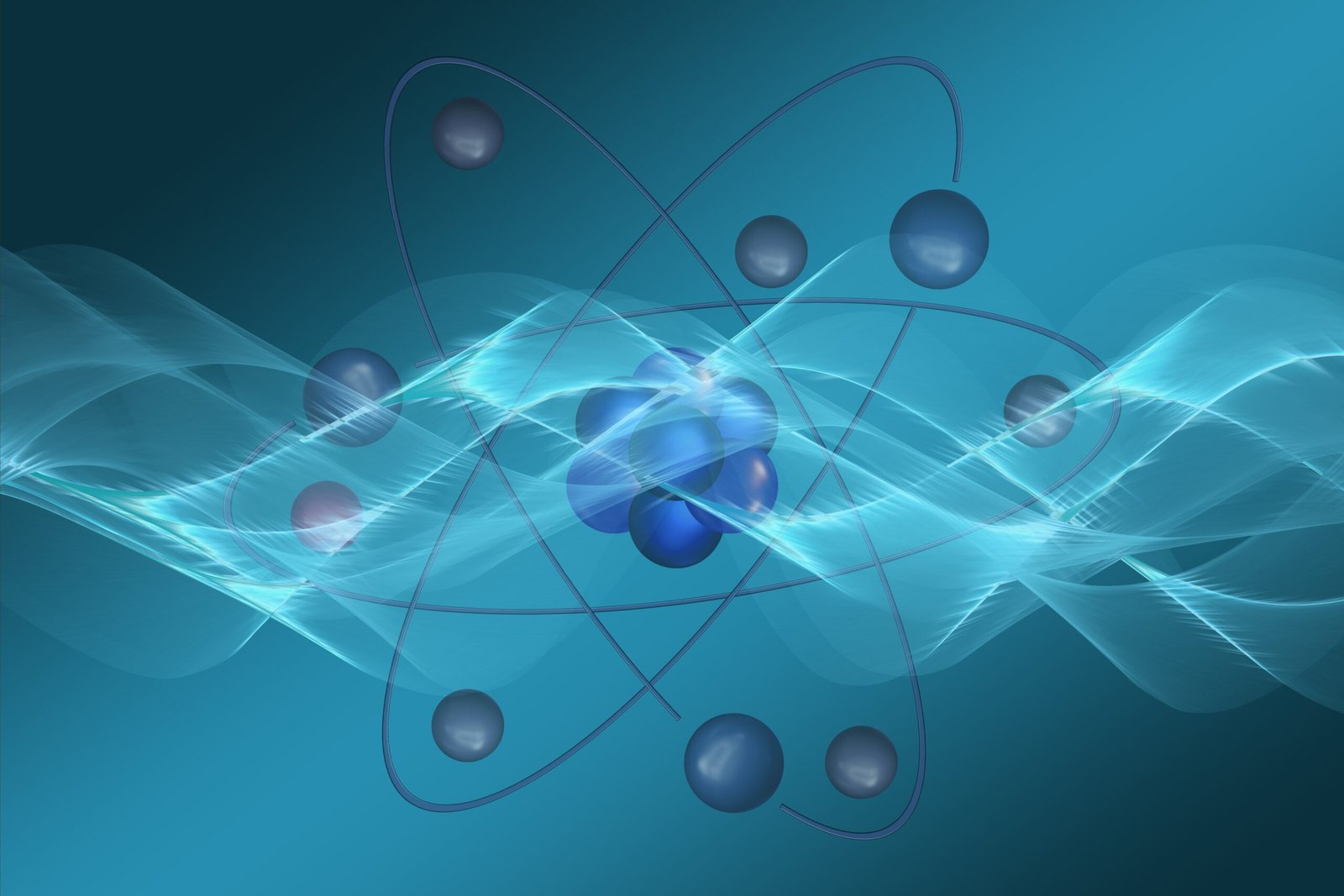

Scientists have directly observed a quantum event called electron-transfer-mediated decay (ETMD), watching three atoms exchange electrons and explode apart a process relevant to understanding how radiation damages cells.
This real-time observation and imaging of atomic-scale ETMD provides direct evidence and unprecedented detail of quantum effects that underlie radiation damage.
Published in the Journal of the American Chemical Society (2026), this study offers the most detailed picture yet of a quantum phenomenon called electron-transfer-mediated decay (ETMD). And while the science sounds deeply abstract, its implications reach directly into how radiation damages our bodies and potentially how we might protect them.
Let’s take a closer look: What is Electron-Transfer-Mediated Decay?
To understand ETMD, you first need to know a little about how atoms handle stress.
When a high-energy X-ray strikes an atom, it can knock out an electron from deep inside the core shell, leaving the atom in an unstable, highly energized state. In isolated atoms, this is resolved locally: nearby electrons rearrange themselves to fill the gap, releasing energy in the process. This process is known as Auger-Meitner decay, where, after core ionization, the atom emits another electron (the Auger or Meitner electron) and stabilizes. Auger-Meitner decay happens extremely rapidly, within femtoseconds a femtosecond is one millionth of a billionth of a second (10^-15 s).
But atoms in real life aren’t isolated. They exist in clusters, liquids, tissues, and cells. And when an atom is embedded in a chemical neighborhood, something far stranger can happen.
Instead of releasing energy locally, the excited atom can ‘offload’ that energy to a neighboring atom entirely. The neighbor becomes ionized, that is, it loses an electron even though it was never directly hit by the original X-ray. This process, called interatomic Coulombic decay (ICD), is a quantum effect first predicted in the 1990s. Coulombic refers to the influence of electrical charges (Coulomb forces) that drive these interatomic processes.
ETMD, short for electron-transfer-mediated decay, goes one step beyond ICD. In ETMD, a neighboring atom doesn’t just accept energy; it donates an electron to the ionized central atom. This transfer releases enough energy to then ionize, or remove an electron from, a nearby third atom. ETMD is thus a kind of atomic chain reaction, triggered solely by proximity and the quantum behavior of electrons.
In biological systems, think of water molecules surrounding a DNA strand. This process can generate reactive species that cause cascading damage far beyond the original X-ray hit. Understanding ETMD is therefore not just a physics curiosity. It’s a blueprint for how radiation damages living tissue.
The Experiment: Three Atoms, Five Particles, One Camera
The research team, led by Florian Trinter and Till Jahnke, chose the simplest possible system that can undergo ETMD(3), a trimer, meaning a cluster of exactly three atoms. Their system: one neon atom (Ne) flanked by two krypton atoms (Kr), forming a loosely bound triangular arrangement roughly the width of 4 ångströms (that’s 0.0000000004 meters).
Here’s how the experiment worked:
- A powerful X-ray beam from two European synchrotron facilities struck the neon atom, knocking out a core electron.
- Within femtoseconds, local Auger-Meitner decay left the neon atom doubly charged.
- The trimer then entered a “waiting period,” remaining in this excited state for up to 1 picosecond (a trillionth of a second). During this time, the atoms weren’t frozen. They were moving.
- Eventually, ETMD(3) occurred: one krypton atom donated an electron to neon, the released energy ionized the second krypton atom, and the trimer underwent a Coulomb explosion, with three charged ions flying apart.
The team detected all five particles produced in the event—two electrons and three ions simultaneously using a method called COLTRIMS (Cold Target Recoil Ion Momentum Spectroscopy). COLTRIMS is an advanced technique for measuring the three-dimensional motion and energy of charged particles. By recording the momentum of each atom, they could mathematically reconstruct the atoms’ positions at the precise instant ETMD occurred.
Over 70,000 such events were recorded and analyzed.
The Surprise: The Atoms Were Roaming
Here’s where the finding gets genuinely fascinating.
Scientists had previously assumed that the trimer would remain close to its original ground-state geometry while waiting to decay into a tidy equilateral triangle, with neon at one corner and two krypton atoms at the other two corners. The prediction was orderly. The reality was not.
The data revealed that most trimers were NOT in their ground-state geometry when they finally decayed. Instead, the atoms were engaged in a complex, wandering dance that the researchers describe as “roaming-like motion.”
In physics, ‘roaming’ is a term from reaction chemistry. It describes a situation in which an atom or molecular fragment travels slowly across a flat, low-energy region of an energy landscape rather than following a direct path. Only after this meandering does it commit to a reaction pathway. Here, the term ‘roaming’ refers to the quantum decay process of a trimer, in which the atoms wander in their arrangement before decaying.
Specifically, the team found a temporal progression:
- 0–20 femtoseconds: Atoms decay near their original triangular geometry.
- 100–110 femtoseconds: The opening angle widens; the neon and krypton atoms draw slightly closer.
- ~250 femtoseconds: Two distinct geometries emerge, one where a krypton atom is close to the neon, and another where it’s far away. This asymmetric configuration is actually optimal for ETMD: the close krypton can efficiently donate an electron, while the far krypton can still receive energy at long range.
- ~360 femtoseconds: The trimer becomes nearly linear, and the neon atom has swung between the two krypton atoms like a pendulum.
- 550–1000 femtoseconds: The trimer has contracted overall and decays across a wide range of shapes, from triangular to fully linear, often exhibiting the largest internuclear distances in the entire dataset.
This pendular, roaming motion isn’t random chaos. It’s a structured atomic choreography, governed by the shape of quantum energy surfaces in three-dimensional space. This discovery raised a key question: Why Does Geometry Matter So Much? So Much?
The efficiency, or speed, of ETMD is extremely dependent on the shape of the three-atom molecule (the trimer). The rate at which ETMD occurs can vary by nearly an order of magnitude (nearly tenfold) depending on how the atoms are arranged. In certain atomic arrangements, ETMD cannot occur because it is not energetically allowed by quantum mechanics.
This is why the temporal mapping matters so profoundly. If you want to model how ETMD proceeds in a real biological environment, say, around a hydrated DNA strand being bombarded with X-rays, you cannot simply assume atoms sit still. The geometry is constantly changing, and the decay probability changes with it.
The team’s combination of experimental data and theoretical simulation allowed them to reconstruct the full three-dimensional geometry of each trimer at the moment of decay. Experiment and theory matched well, providing a valuable benchmark for future modeling work.
What This Means for Radiation Biology and Medicine
The broader implications of this research sit squarely in radiation biology.
ETMD efficiently produces reactive species and ions in water-rich biological tissue. Because DNA is surrounded by water, ETMD is a credible pathway for radiation-induced DNA damage beyond direct X-ray hits.
Recent experimental work has confirmed that ETMD occurs in liquid water and in the vicinity of solvated ions. But modeling these large, complex systems from first principles remains computationally infeasible.
Prototype studies like this are essential. By characterizing ETMD in the simplest three-atom system, researchers provide benchmarks for computational models that can simulate radiation damage in DNA-sized systems.
The authors specifically suggest that their results can enable QM/MM (quantum mechanics/molecular mechanics) frameworks, where fragment-level ETMD data feeds into simulations of fullThe authors specifically suggest that their results can enable QM/MM (quantum mechanics/molecular mechanics) frameworks. In these hybrid simulation approaches, fragment-level ETMD data from quantum mechanical calculations are used within larger molecular mechanics models to simulate complex biological environments. On imaging, the technique of inferring geometry from explosion momenta has been used before. But using ETMD itself as the imaging trigger, combined with femtosecond-to-picosecond time resolution, allows scientists to watch molecular dynamics unfold rather than just snap a single frozen frame.
In the future, this approach could be applied to larger, more biologically relevant clusters, helping scientists map the real-time atomic choreography that underlies radiation damage, drug binding, and molecular chemical reactions.
The Bottom Line
A team of physicists and chemists used one of the most sensitive particle detectors in the world to track three atoms through an extraordinary quantum event and discovered that the atoms were doing something no one had directly observed before: roaming, swinging, and rearranging themselves in complex patterns before decay.
It’s a finding that bridges quantum physics, chemistry, and biology. It deepens our understanding of how radiation hurts living cells and opens a new window into watching molecular dynamics in real space and real time.
Science, it turns out, has finally found a way to film the invisible dance of atoms.
References
Trinter, F., Hofierka, J., Rist, J., et al. (2026). Tracking the Complex Dynamics of Electron-Transfer-Mediated Decay in Real Space and Time. Journal of the American Chemical Society, 148, 4126–4135. https://doi.org/10.1021/jacs.5c15510