


Breast cancer is still the leading cancer killer among women, with 2.3 million new cases recorded and 660,000 deaths in 2022 alone. And once treated, there is a 10- 30% danger of relapse 10-30% depending on stage, subtype, etc. Even though meds and surgery are critical, new studies have drawn attention to exercise as an ally. An article published in Breast Cancer Research and Treatment in 2025 would show how a single resistance training (RT) or high-intensity interval training (HIIT) session mirrors the actions of anti-cancer proteins and inhibits the growth of cancer cells in experiments by increasing mitochondrial mass and disrupting their metabolic capabilities in survivors.
The trial, conducted by Robert U. Newton at Edith Cowan University, used 32 breast cancer survivors, with an average age of 57 years, following treatment. They were randomly assigned to RT (weights such as leg press) or HIIT (cycling bursts), and exercised once. Myokines-muscle-derived proteins that are anti-cancerous- were measured in blood collected before, immediately (0P), and 30 minutes (30P) after.
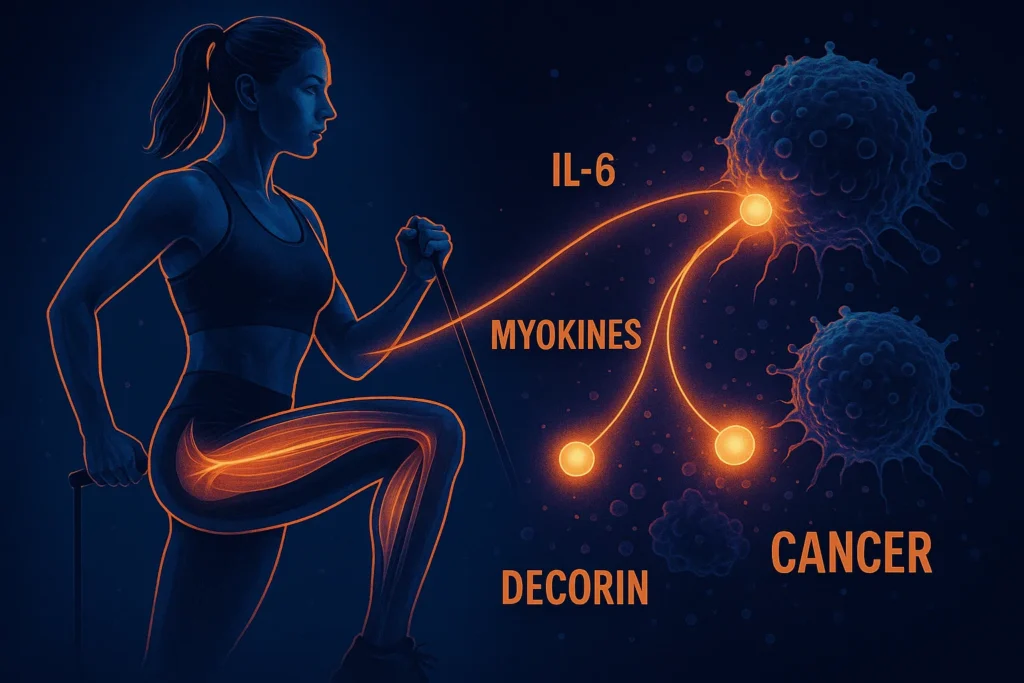
Myokines: Secret weapon of muscles against cancer
Decorin, IL-6, SPARC, and OSM are myokines that combat the tumor by interfering with the signal to grow cancer, induce apoptosis (because of caspase-3 activation), and inhibit Burst. Following exercise, in both groups, there was a 9- 47 percent increase in post-exercise decorin, IL-6, and SPARC at 0P. At 30P, IL-6 remained elevated at 30P; OSM was elevated only in RT at 30P.
HIIT beat RT on the IL-6 spike at 0P, though both did. Why? Exercise causes myokines to be released due to stress to the muscles. RT makes people strong; HIIT makes people cardiovascularly fit, and both engage similar anti-carcinogenic biology.
Lab Proof: Use Exercise Serum to Decelerate Cancer Cells
The actual excitement? The post-exercise blood serum of the survivors inhibited an aggressive breast cancer line (MDA-MB-231) by 19-29 percent at 0P and 30P. HIIT had yeast inhibitory levels that were stronger at 0P.
Real-time analysis was applied in this in vitro test: the cells that were tested in 5% serum developed at a slower rate after the exercise. Changes induced by exercise did; baseline serum did not. It is implied that myokines fight cancer directly, and they can reduce recurrence.
Why This is Important to the Survivors
The fear of developing breast cancer recurrence is common. The guidelines on exercise suggest 150 minutes moderate or 75 vigorous in a week in addition to resistance a couple times every week. There is only one session that helps; this research is handy for busy or healing types.
Other perks include: Workout alleviates side effects of chemo, elevates spirits, strengthens bones. It is promising in the case of triple-negative cancers (such as MDA-MB-231), where very little could be done.
Limitations? Sample size, one bout- not known what it can give him in the long term. Subjects were fit survivors; the outcomes might differ in other persons. Future studies: chronic exercise, groups of different kinds, in vivo.
Practical Tips: Start Your Anti-Cancer Workout
Set to tap this? Doctors must be consulted, especially after treatment.
RT Basics: Bodyweight or bands-squats, push-ups, rows. Aim 3, twice a week, 8-12 reps, sets.
HIIT How-To: Cycle or walk fast- 30 sec on, 90 off, 20- 30 minutes.
Monitor Improvement: Use coping Apps such as MyFitnessPal; be involved in survival groups.
Nutrition Boost: Foods containing protein after a workout facilitate myokine liberation.
There is increased evidence: Physical activity acts similarly to medicine, locating cancer with no unwanted effects. A 2023 review associated frequent activity with 20-30 % reduced relapse.
Bigger-picture Implications: Exercise as Medicine
This fits with the statement of off-exercise oncology, or in other words, using workouts as a therapeutic means. With other types of cancer (prostate, colon), parallel myokine effects have been observed. The initiative of encouraging physical activity could reduce the scourge of cancer around the world.
In case of non-survivors: Prevention tool. The hazards of struggling against cancer increase with sedentary lifestyles, and they decrease with active lifestyles.
Put your mind and muscle to it: One workout triggers a transformation. According to Newton, exercise provides promising anti-cancer factors.
Be active, be strong; your physique will fight.
References
Bettariga, F. et al. (2025). A single bout of resistance or high-intensity interval training increases anti-cancer myokines and suppresses cancer cell growth in vitro in survivors of breast cancer. Breast Cancer Research and Treatment, 213:171–180. https://doi.org/10.1007/s10549-025-07772-w
Hayes SC et al. (2019). Exercise medicine in cancer management—Journal of Science and Medicine in Sport.
Pedersen, B. K. (2013). Muscle as a secretory organ. Comprehensive Physiology.